From Research to Real World Impact: Building a More Sustainable Future for Rivers
 India. Thailand. Singapore. Three countries, three stages of an academic journey and one evolving research question: What happens when the sand beneath our feet becomes a resource worth fighting over?
“Sand is one of the world’s most important natural resources,” Dr Sonu Kumar explains. “It is used to build our homes, roads and cities, but much of it comes from rivers. The challenge is that sand mining often takes place underwater, making it difficult to monitor how much is being removed and the impact this has on the environment.”
Dr Kumar’s academic journey has taken him from India to Thailand and, eventually, Singapore. He completed his undergraduate degree in India, where his research first introduced him to rivers, sediment and water-related challenges. He then pursued a Master of Engineering at the Asian Institute of Technology in Thailand, focusing on the use of satellite rainfall data for river-flow modelling in data-scarce Himalayan regions.
After graduating, he worked as an environmental engineer in Thailand, gaining practical experience through water and wastewater treatment projects. Yet the experience also prompted a deeper question about where he wanted to take his career.
“Working as an engineer was valuable because it gave me practical experience, but it also made me realise that I wanted to go deeper into research,” he says.
He became particularly interested in how emerging technologies could be used to understand environmental problems on a much larger scale, ultimately motivating him to pursue a PhD.
When the opportunity arose to undertake river and environmental research at the National Institute of Education, Nanyang Technological University, Singapore (NIE NTU, Singapore), he felt it was the right next step. “I moved to Singapore in 2022, and that decision eventually took my research in directions I had never expected when I started.”
A key reason Dr Kumar chose NIE was the opportunity to work with Associate Professor Edward Park, an academic authority in the same field. Associate Professor Park’s research on rivers, remote sensing and environmental change closely aligned with his interests. Ultimately, however, it was the interdisciplinary nature of the research that made NIE stand out.
Dr Kumar’s PhD journey was also supported by the NIE PhD Scholarship, which allowed him to focus on his research while presenting his work and developing international collaborations. With the scholarship, he was able to immerse himself fully in the university’s research environment.
“My PhD was not limited to one field,” Dr Kumar explains. “I had the opportunity to combine river science with satellite remote sensing, artificial intelligence, big data analysis and environmental modelling.” This allowed him to continually develop new skills and explore different approaches as his research evolved.
Being part of the wider NTU research environment further expanded those opportunities. While working closely with his supervisor and colleagues at NIE, Dr Kumar was able to collaborate with researchers across disciplines and institutions internationally. “Looking back, this combination of close mentorship and a much larger research environment was very important to my development,” he reflects.
Dr Kumar counts his supervisor, Associate Professor Park, as one of the greatest influences on his development during his PhD studies at NIE. “He gave me the freedom to explore new ideas while continuously encouraging me to think bigger about the research,” he recalls.
Recounting his first experiences at NIE, Dr Kumar describes a welcoming research environment in which he did not feel that his PhD had to remain within one narrow discipline. One of the experiences that left the deepest impression on him was seeing the different strands of his research gradually come together. He began by exploring whether satellite imagery and artificial intelligence could be used to detect sand-mining activities in large rivers. Once that proved possible, the research led to a bigger question: How much sand was being removed, and what impact was this having on the river?
Answering that question took him into environmental and hydrodynamic modelling. Eventually, his research enabled him to compare the Mekong Delta under current conditions with a counterfactual scenario without sand mining, helping to distinguish the impacts of mining from other environmental pressures.
“Seeing a research question develop from satellite observations into something that could actually help us understand and manage a major environmental problem was probably one of the most exciting parts of my PhD,” Dr Kumar says.
Dr Kumar’s research focused on developing a way to monitor sand removal and its environmental impact. His
approach uses imagery and artificial intelligence to detect sand-mining activities, computer models to measure their environmental impact, and a decision-making framework to identify where sand could be extracted more sustainably.
“People should care because excessive sand mining can deepen rivers, increase erosion, damage infrastructure and allow saltwater to move further inland, threatening freshwater supplies, agriculture and the livelihoods of river communities,” Dr Kumar cautions.
Testing his approach in the Vietnamese Mekong Delta, where around 45–50 million cubic metres of sand are extracted every year. This is far more than nature can replace. Dr Kumar found that a more sustainable level would be around 9–10 million cubic metres annually. The Mekong Delta’s environmental challenges have often been associated with climate change, sea-level rise, upstream dams and land subsidence. While these are all important, Dr Kumar’s research showed that poorly managed sand mining is also a major driver of environmental change.
“We found that sand mining contributed around a quarter of the riverbed erosion across the delta and accounted for up to 30% of the increase in saltwater intrusion during the dry season,” he shares.
For the first time, Dr Kumar’s research clearly separated the effects of sand mining from the other pressures affecting the delta, providing concrete evidence that improved sand-mining management can make a real difference.
Although Dr Kumar’s research focused on the Mekong Delta, the same approach could help protect vulnerable rivers around the world. His findings were later published in Science Advances.
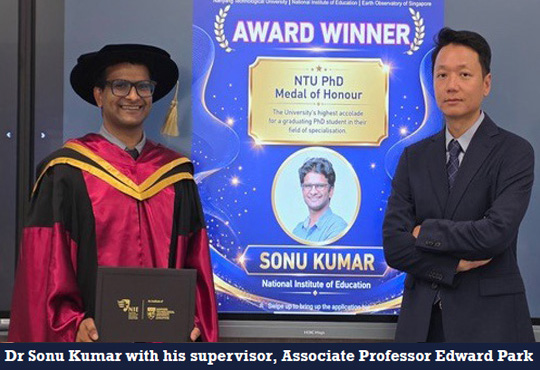
Towards the end of his PhD journey, Dr Kumar received the NTU PhD Medal of Honour, NTU’s highest accolade for a graduating PhD student whose research demonstrates exceptional excellence, originality and innovation, and has achieved significant academic or societal impact. The prestigious award recognised Dr Kumar’s research and its potential for real-world application. He now wants to explore how his work could extend beyond the Mekong Delta and academia.
“One of my main goals is to translate the research into something that governments and organisations can actually use,” Dr Kumar says. He is currently developing a start-up initiative, EcoMine Global, aimed at bringing sustainable sand-management technology into real-world use. Through it, he hopes to answer three practical questions: Where is sand being mined? What environmental impacts is it causing? And where and how much sand can be extracted more sustainably?
For those considering a PhD at NIE NTU, Singapore, Dr Kumar offers this advice: Choose your research problem and supervisor carefully. “You are going to spend several years working on that problem, and having a supervisor who supports your ideas and allows you to grow can make a very big difference.”
The National Institute of Education (NIE) is an autonomous institute of Nanyang Technological University (NTU), Singapore. Ranked among the world’s top 12 universities, NIE is also among Asia’s top three institutions for Education and Training in the Quacquarelli Symonds (QS) World University Rankings by Subject.
Ready to take the next step in your postgraduate education? Applications for NIE’s August 2027 intake close on 30 December 2026 for research programmes and 15 January 2027 for coursework programmes. Visit https://ntu.sg/ nieGradProgIntake for programme details and application information.
Current Issue