How to Apply for an Education Loan in India
Choosing the right lending Institution
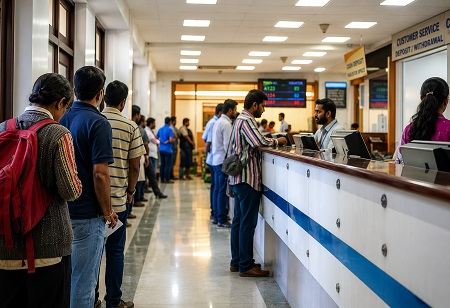 Since different lenders have different interest rates, repayment policies, eligibility requirements, and processing fees, one must compare at least two lenders prior to choosing.
Education loans are easily available from banks in the public sector, private banks, and non-banking financial companies (NBFCs). Though public sector banks can offer low-interest rates, private banks and NBFCs are able to give faster decisions and flexible policies.
While selecting the most suitable lender, it is imperative to compare a number of factors like interest rate, repayment period, processing fee, maximum amount of loan, moratorium period, and collateral requirement.
- Interest Rate: Compare the interest rate that you are actually being offered, and see if the rate is fixed or floating. Moreover, learn about the benchmark and spread for a floating interest rate.
- Processing and Other Charges: Examine check processing fees, administrative fees, documentation fees, insurance requirements, and other relevant costs. It is possible that despite having a low interest rate, you will still incur higher expenses in obtaining a loan.
- Loan Amount and Funding Coverage: Discover how much the lender will fund, as well as which costs can be financed, such as school fees, boarding, textbooks, travel, and other education-related expenses.
- Collateral Requirements: Find out if there is an option to obtain a loan without any collateral, and if security is needed, know what kind of assets the bank requires and what portion of the loan they should cover.
- Moratorium Period: Consider the length of time for which the payment can be postponed. Various systems of loaning money for studies offer moratorium on the period of the course plus the fixed grace period.
- Repayment Tenure and Flexibility: An extended period may help lower the EMI payments but will result in higher overall interest payments. Make sure you know if it is possible to foreclose your loan without any penalty.
- Eligibility of the Course and Institution: Make sure that the lender funds your course alone. There are some lenders that have specialized loan programs for premier universities and colleges and certain courses.
- Disbursement Process and Speed: Know the speed at which the loan gets sanctioned and disbursed. This becomes more important when there are specific deadlines for paying tuition fees. According to Axis Bank, disbursal takes place in 7-15 working days from the time a complete application and all other supporting documents are received.
- Customer Service and Accessibility: Think about the bank’s branch network, online application process, and how responsive and accessible their education loan department is. An easily accessible lender will make the sanction and release process much easier.
- Overall Cost of the Loan: Ultimately, take into account the entire repayment responsibility rather than only the quoted interest rate. Consider interest incurred during the moratorium period, application fees, fees associated with the collateral and more before deciding.
The key principle is to select the creditor that is most affordable and whose loan covers your needs, while allowing for easy repayments and reasonable costs, instead of always opting for the one that gives the lowest interest rates.
“Education loans are critical in ensuring that a student’s access to higher education is determined by merit and aspiration, rather than by the financial circumstances or socioeconomic background of their family. India now has approximately 4.5 crore students enrolled in higher education, yet its Gross Enrolment Ratio remains only 30%, indicating considerable scope for expansion. Well-designed loans can ease immediate credit constraints and enable students to invest in their future earning capacity.
However, it remains essential that loans complement, not replace, scholarships and public funding. They should be collateral-free, transparent and accompanied by interest support and repayment terms linked to employment, income and make space for the students' career growth. The true measure of success is not simply the amount disbursed, but whether first-generation and disadvantaged students enroll, complete their education and secure meaningful employment without facing unsustainable debt,” says Aditi Bhutoria, Associate Professor, Public Policy and Management, Indian Institute of Management Calcutta.


Current Issue