
How AI can Reduce Risks in Farming
 The Indian agriculture sector is less an industry, it is more a structured confrontation with uncertainty. The monsoon has its own behaviours - sometimes it distributes bounty, other times excess and some other seasons it goes bleak. Its rules are such that no one has been able to fully decode it. For a sector which has a good majority of the Indian population depending on it and contributes around 17-19 percent of GDP, and with climate change challenges abound, the information asymmetry is a constant battle, and it is many a time one-sided.
With the emergence of artificial intelligence (AI) and its introduction in agriculture, farming is becoming more predictable, resilient, and data-driven. Besides reshaping Indian agriculture, the impact of AI is reaching far beyond the fields. By blending technology with sustainability, it is opening dynamic career pathways for India’s youth. For students and young professionals, agri-AI represents more than rural innovation; it marks the rise of a purpose-driven, future-ready ecosystem of opportunity.
Acute emerging challenges
The effects of climate vagaries are worrying. The constant fluctuation hits the majority of farming communities, the small and marginal farmers the most, who make up a good 86% of India’s farming population. These farmers, who cultivate in less than two hectares, can certainly benefit with better information based on which that they could partially anticipate.
How is AI collapsing the information horizon?
While on one hand we have a range of AI tools and applications that are bringing in increased efficiency in farm tasks, what is increasingly critical is how AI is compressing the information asymmetry between those who price agricultural risk and those who bear it.
A commodity trader who is looking to price the harvest has access to a range of weather forecasts, satellite-derived crop stress indicators, soil moisture anomalies and demand signals from various wholesale markets simultaneously. The marginalized small-land-holding farmer did not have that information earlier. What AI does is not to equalize this gap entirely, but in a way compresses it at the margins where most farm decisions are made. This information, between a correct and incorrect call, is the difference between a season’s profit and a season's debt.
Substantial Progress
The data to back this is now substantive. A meta-analysis synthesizing experimental studies across a range of diverse agro-climatic conditions quantified AI-driven irrigation optimization as generating water savings of 30-50% and yield improvements of 20-30%. If India can work towards such an improvement, it will represent a structural economic shift rather than a marginal efficiency gain. We are already seeing pretty successful outcomes in India in various locations.
For example, a pilot by the World Economic Forum in Khammam district, Telangana, combined satellite soil analysis, computer vision crop assessment and algorithmic market linkage, which saw a healthy outcome. The harvest saw a 21 percent increase in yield for chili farmers and interestingly, there was an 8 percent improvement in the price for harvest over an 18-month period. This goes to prove that productivity gain and market gain can be arrived by strategic leverage of AI, which can compound benefits for marginalised farmers.
While the agriculture sector will certainly benefit across the farms by smart usage of AI, it can also be harnessed for how it can drive efficiencies in agriculture finance, from credit to insurance.
The satellite-based AI can assess crop losses farm-by-farm in days of a weather event, with precision and accuracy, triggering payouts that turn insurance into instant liquidity. This can help farmers to plan the next crop cycle with confidence, while skipping the stress of raising credits. In credits, AI can help lenders understand yield probabilities for a specific farm and can price the loan based on evidence rather than assumptions. This unlocks capital for those who need it most, omitting opacity.
Also Read: How Students can Make Smart Career Choices for Success
How India is leveraging this?
The Government of India’s IndiaAI Mission of 2024 has committed a massive Rs 10,300 crore to a national AI ecosystem in which agriculture is an explicit priority. We also have the Digital Agriculture Mission aligning with another Rs 2817 crore towards farmer-centric digital infrastructure. Aligning with these, is the AgriStack initiative which is building out a data layer, linking the identity of the farmers, land title, soil records and financial history, which has the potential to transform AI models from generic advisory tools into farm-specific decision engines.
The Government of India has further doubled down and set up three AI Centres of Excellence funded by the Ministry of Education to the tune of Rs 990 crore. The CoE for agriculture will work towards integrating AI technologies, which will enhance efficiencies in precision farming, enhance yield predictions, and data-driven decision-making tools to optimize resource use and crop management.
What sets India apart is its growing leadership in agri-AI research, where academic institutions and innovation hubs are building solutions for the world’s most complex farming conditions. In doing so, India is shaping AI models that are not only locally effective but globally exportable.
Career Opportunities in Agri-AI
The implementation of AI in agriculture has opened doors to an array of career opportunities. While many believe that AI is just relevant to the tech and software industry, it also has huge potential in agriculture. Young professionals have ample opportunities to choose a different career path while combining innovation and sustainable practices. Some of the career options in Agri-AI include:
Data Scientists/Machine Learners: Data Scientists and Machine Learners are Professionals with the help of AI can predict the yield of crops, pest infestations, and weather predictions for better farming.
Remote Sensing/GIS Specialists: With the help of satellite imagery and geospatial data, experts can monitor the condition of crops and soil.
Drone Operators/Crop Monitors: Drones can be used to identify crop disease and damage.
Climate Analysts: With the help of forecasting models, analysts can identify and understand climate risks for farmers.
IoT Engineers/Smart Sensor Developers: With Agri-AI, experts can measure and manage parameters like soil moisture and temperature.
With India focusing on its digital agriculture and AI infrastructure, agri-AI is providing young professionals with meaningful career opportunities.
Road Ahead
What is unique in India is our agricultural heterogeneity. The same complexity is a blessing in disguise as it is the best training ground for AI models which can be robust to function across the many countries in the world.
The global AI agriculture market, valued at $4.7 billion in 2024 and expanding at 26.3 percent annually is expected to touch the $46 billion market over the decade, will be shaped by entrepreneurs who builds tools that delivers under conditions of data scarcity, infrastructure constraint, and high linguistic fragmentation.
India is best placed to build these tools to be implemented at scale. We must however ensure that the resulting intelligence is for the larger public good rather than a proprietary asset
About the Author:
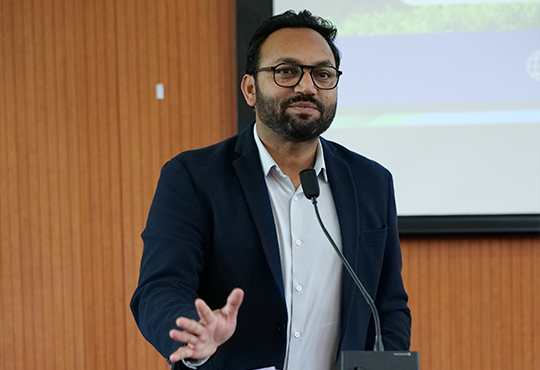
Pushpendra P. Singh is an experimental physicist and Project Director of ANNAM.AI at IIT Ropar, driving AI-led transformation in sustainable agriculture. He leads the development of farmer-centric solutions including crop intelligence, advisory systems, and precision farming technologies. An internationally experienced researcher, he has received accolades including the INFN International Fellowship and the Prof. C. V. K. Baba Best PhD Thesis Award.
Current Issue
.jpg)