Srimathi Devkunvar Nanalal Bhatt Vaishnav College For Women (SDNBVC): Building Tomorrow’s Pioneers In Ai & Robotics
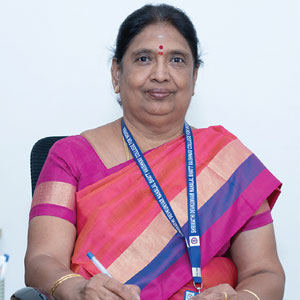
By Dr M.S. Vijaya, Director

The field of AI and robotics is dealing with intense challenges amid rapid technological advancements. A critical skill gap persists, as educational systems struggle to keep pace with industry demands for expertise in Machine Learning, Data Analytics, and Automation.
This leaves graduates underprepared for real-world applications. Ethical concerns such as AI bias, Data Privacy and Responsible Innovation, add complexity while the underrepresentation of women in STEM exacerbates inclusivity issues.
The global AI market is projected to rise by a CAGR of 14 percent by 2030 to reach an amount of $1.8 trillion due to the efforts of industries such as the healthcare industry, the financial industry, and the agricultural industry.
Shrimathi Devkunvar Nanalal Bhatt Vaishnav College for Women (SDNBVC) is addressing these challenges through a tech-centric education in AI and robotics. Established in 1968 as the first women’s college in Kanchipuram district, Tamil Nadu, it began with a generous donation of 10 acres of land from the Founder and Chairman, Nanalal Bhatt, and 6 lakhs from the Cork Industries Charities Trust.
Named for honoring his wife, Devkunvar, the institution was envisioned to empower women through accessible education. At the support of 300 dedicated employees, it has grown beyond the 300 pre-university students to around 7,000 of the current students, 30 percent of which were under the Aided streams and 70 percent were under the Self- Supported streams. The institution is affiliated with the University of Madras.
Innovative Academic Program
SDNBVC has contributed to enhance the education of AI and Robotics in India, particularly among the female population, by integrating innovative programs into its educational curriculum.
“The college is highly innovative, with 33 Under Graduate, 15 Post Graduate and 9 Ph.D Research programs. As a response to such demands in intensive fields, it is offering B.Sc. programs in ‘Data Science & AI’ and ‘Fintech & AI’ during the Academic Year 2025-2026. B.Sc. Computer Science with AI, B.Sc. Computer Science with Data Science is the prevailing courses that emphasize applied training to equip the graduates to join the industry.
This program will help to bridge the gender gap in STEM as it empowers women and creates a new cohort of tech leaders”, says Dr M. S. Vijaya, Director, whose dynamic leadership has created a paradigm shift in teaching-learning process at Shrimathi Devkunvar Nanalal Bhatt Vaishnav College for Women.
The students come up with the projects that relate to monitoring carbon footprint, auto-identifying objects, intelligent waste management, and smart farming, using the Internet of Things (IoT). “One of our outstanding innovations is a Humanoid Robot to assist in admissions-guidance and library-updates through generative AI to increase interactive learning,” says Dr N. Priya, Dean (Research), SDNB Vaishnav College for Women. The Artificial Intelligence Club organizes presentations, Idea-thons, Hackathons, and publishes magazines and nurtures innovation and connection.
Global Industry Partnerships
The college ensures industry readiness through active partnerships and practical projects to ensure that the students are ready to enter a fast-paced AI/ robotics industry. Partnerships with companies such as Face Prep, Guvi HCL, L&T and Wipro make people acquainted with new trends and real world applications.
The college focuses on the development of skills in women, and its women-centric skill-building center is equipped with a Center of IoT and Robotics to provide intensive training in certification programs and practical training opportunities using such tools as Arduino, ESP32, Raspberry Pi, Python, and TensorFlow.
What sets SDNBVC’s AI and Robotics courses apart is their unique blend of theoretical knowledge and practical applications, preparing students for global-tech industries. The curriculum has been designed to offer a high academic standard on AI, Machine Learning, Data Science, and Robotics, which are updated annually through the Board of Studies with industry professionals and academicians as well as alumni.
In partnership with industry giants such as Face Prep, Guvi HCL, L&T and Wipro, capitalizing on project, certification and mentorship, it offers project based learning in both academia and industry. Such a combined course naturally develops competencies in programming, automation, and AI ethics so that the graduates can fulfill their mission in research, entrepreneurship, or corporate jobs globally.
If women lead in shaping the future, the future will be shaped for everyone. Empowering women to lead in AI and robotics is key to building a future that is innovative, inclusive, and equitable. Women can design solutions for their own needs, improving quality of life.
Future-Ready Skill Training
SDNBVC aligns its curriculum with current trends, ethical considerations, and industry demands via rigorous processes. Annual Board of Studies Revisions incorporates advancements such as generative AI, edge-computing, IoT-integrated Robotics and AI ethics. “To build practical skills and exposure to our students, we provide workshops, seminars and internships through industry academia partnerships”, says Dr N.Priya.
Through MoUs for skill training, certified courses and mentorship with Face Prep, Guvi HCL, L&T, and Wipro, collaborations define pedagogy. Hackathons, Collaborative Research, co-developed modules, and innovation challenges encourage entrepreneurial and problem solving skills. Looking ahead, SDNBVC’s roadmap includes an AI and Robotics Innovation Lab with simulation tools robotic arms and collaborative robots.
These plans involve such elements as cloud platforms to carry out remote AI/ML experiments, VR/AR modules to conduct immersive training, collaborations with other nations to organize joint certifications and exchanges, and social good initiatives in areas such as sustainability, medical assistance, and rural development.