
Beyond CCTV: How AI Is Revolutionizing Campus Security
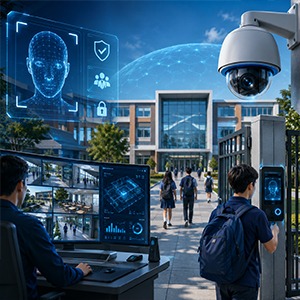 Universities and educational institutions are under increasing pressure to create safer learning environments while managing large, open campuses. Security challenges have evolved beyond theft and vandalism to include unauthorized access, campus violence, emergency response, and protecting students, faculty, and visitors.
According to the National Center for Education Statistics (NCES), about 93% of U.S. public schools used security cameras during the 2021 to 2022 school year, highlighting how video surveillance has become a standard part of campus operations. Meanwhile, Fortune Business Insights projects the global physical security market to exceed $200 billion by 2032, fueled by rapid adoption of artificial intelligence, cloud technologies, and smart automation.
While traditional CCTV systems have played an important role for decades, simply recording incidents is no longer enough. Universities need technology that can recognize threats as they happen, alert security personnel instantly, and support faster decision making during emergencies. Modern school security systems combine AI-powered analytics, cloud management, and intelligent access control to move campus security from reactive monitoring to proactive protection.
Why Traditional CCTV Is No Longer Enough
Conventional CCTV cameras are designed to record events for later review. While recorded footage can be valuable during investigations, it rarely helps prevent incidents before they occur.
Large campuses often have hundreds of cameras spread across lecture halls, dormitories, research facilities, libraries, parking lots, and athletic venues. Expecting security teams to monitor every screen continuously is unrealistic, especially when staffing resources are limited.
As universities expand, security teams require smarter technology that actively supports their work instead of simply generating more video footage to review after an incident.
Why AI-Powered School Security Systems Matter
Artificial intelligence has transformed surveillance from passive observation into proactive protection.
Instead of relying entirely on human operators, AI continuously analyzes live video feeds to identify suspicious behavior, unauthorized access, loitering, perimeter breaches, or activity in restricted areas after hours. Security personnel receive alerts only when meaningful events occur, allowing them to respond more quickly and efficiently.
This intelligent approach reduces false alarms while helping security teams focus their attention where it matters most.
Smarter Access Control Creates Safer Campuses
Universities function like small cities, with thousands of students, faculty members, contractors, visitors, and service providers moving between buildings every day.
Modern access control systems simplify this complexity by using mobile credentials, digital IDs, and automated permissions to regulate who can enter specific facilities. Residence halls, laboratories, administrative offices, and research centers can each have customized access policies without slowing legitimate users.
When access control is integrated with video surveillance, security teams gain better visibility into access events, making investigations faster and improving overall campus safety.
Faster Incident Response Through AI
During emergencies, every minute can make a significant difference.
Traditional investigations often involve manually reviewing hours of recorded footage before identifying the relevant event. AI-powered video search dramatically reduces this process by allowing security personnel to locate footage using descriptive searches, such as clothing color, vehicle type, or movement patterns.
Real-time alerts also help campus police respond immediately to developing situations instead of discovering them long after they have occurred. Faster detection leads to faster response, which can significantly improve outcomes during emergencies.
Modernizing Existing Infrastructure
Many universities hesitate to upgrade security because replacing hundreds of cameras across multiple buildings can be expensive and disruptive.
Fortunately, modern AI platforms often work with existing IP camera infrastructure, allowing institutions to improve security capabilities without starting from scratch. This approach reduces installation costs, minimizes operational disruption, and protects previous technology investments.
Platforms such as Coram.ai demonstrate this approach by adding AI-powered video analytics, intelligent search, cloud management, access control, and real-time alerts to existing camera networks. Rather than replacing hardware, universities can strengthen their school security systems while gaining centralized visibility across multiple buildings and campuses.
Cloud Technology Simplifies Multi-Campus Security
Many higher education institutions operate multiple campuses, satellite facilities, and research centers spread across different locations.
Cloud-based security platforms make it possible to manage these environments from a single dashboard. Security administrators can review live video, investigate incidents, manage user permissions, and receive alerts remotely without maintaining separate systems at every location.
This centralized approach improves operational consistency while reducing the administrative burden on campus IT and security teams.
Preparing Universities for the Future
Campus security continues to evolve alongside advances in artificial intelligence and digital infrastructure.
Future-ready universities are investing in technologies that support predictive security, intelligent automation, and connected emergency response rather than relying solely on traditional surveillance.
As student populations grow and campuses become increasingly connected, security solutions must remain flexible enough to integrate with new technologies while continuing to protect people, facilities, and valuable research assets.
Investing in scalable, AI-driven security today positions institutions to meet tomorrow's challenges with greater confidence and efficiency.
Conclusion
Campus safety is no longer achieved by simply installing more cameras. Educational institutions need intelligent technologies that can recognize risks, automate routine monitoring, and support faster decision making during critical situations.
Modern school security systems combine AI-powered surveillance, smart access control, cloud management, and real-time analytics to create safer learning environments while reducing the workload on security personnel. As universities continue their digital transformation, adopting proactive security technologies will play a vital role in protecting students, faculty, visitors, and campus operations for years to come.
Frequently Asked Questions
1. What are AI-powered school security systems?
AI-powered school security systems use artificial intelligence to analyze surveillance footage in real time, detect unusual activity, automate alerts, and help security teams respond more quickly to potential threats.
2. How are AI surveillance systems different from traditional CCTV?
Traditional CCTV primarily records footage for later review, while AI-powered surveillance analyzes live video, identifies suspicious activity, and provides immediate alerts that support faster intervention.
3. Can universities upgrade security without replacing existing cameras?
Yes. Many modern platforms integrate with existing IP cameras, allowing universities to add AI capabilities, cloud management, and intelligent video analytics without replacing their current infrastructure.
4. Why is integrated access control important on university campuses?
Integrated access control ensures only authorized individuals can enter sensitive areas such as laboratories, residence halls, and administrative buildings while providing security teams with better visibility into access events.
5. What should universities look for in a modern campus security solution?
Institutions should prioritize solutions that offer AI-powered analytics, cloud-based management, real-time alerts, intelligent video search, scalable deployment, and integration with existing security infrastructure to maximize both safety and operational efficiency.
Current Issue