Contineo: Bringing Practical AI to India’s Examination Ecosystem

Aparna Mokhasi, Co-Founder & Director, Contineo
While much of education technology is still demonstrating artificial intelligence on slides, Contineo is already putting it to work in production - identifying blank pages in answer scripts, flagging students at academic risk before they begin to struggle, and doing so using the live institutional data accumulated over years of operation.
It is an approach consistent with how Contineo has grown over the past fifteen years: quietly, organically, and without a dedicated sales force, relying instead on referrals from institutions that have stayed with the company for years. The story of Contineo, then, is not simply about adopting AI. It is about how one of India’s early academic-autonomy technology pioneers built the data, domain expertise, and institutional trust required to make applied AI genuinely useful in higher education.
The Gap Between the Demo and the Deployment
Inside examination evaluation centres at some of the country’s leading institutions, its AI is already working alongside evaluators. Scriptometer, Contineo’s patent-pending innovation, analyses scanned answer scripts, identifies blank pages that evaluators would otherwise have to navigate manually, and streamlines the valuation process - without interfering with academic judgment.
The same philosophy extends beyond examinations. Drawing on years of structured institutional data, Contineo’s predictive models can identify, as early as the admission stage, students who may be more likely to face academic difficulty. This gives institutions an opportunity to begin mentoring and targeted intervention early - rather than waiting for examination results to reveal that a student is already struggling.
“The real test of AI isn’t what you can demonstrate. It’s what you are willing to run in production, on a real exam, with a real student’s result on the line”, says Sudhindra Mokhasi, Founder & CEO.
 A Pattern of Arriving Early
Founded by the husband-and-wife team of Sudhindra and Aparna Mokhasi, Contineo did not enter an existing market; it created one. Sudhindra, who formerly headed global technology solutions at Mphasis, and Aparna together built Contineo from first principles as a platform for academic autonomy and Outcome-Based Education - a category that, in Sudhindra’s words, “did not exist when we launched.”
The early-arrival pattern repeated itself. Contineo had Washington Accord-aligned OBE working with KLE Technological University in 2012, two years before outcome-based education became mainstream practice. It chose SaaS delivery long before that was the obvious choice. The result is a company with marquee, long-tenure customers, among them M S Ramaiah Institute of Technology and KLE Tech, and a retention record guarded fiercely across fifteen years. Today, by its own reckoning, Contineo serves roughly two in five of the VTU autonomous institutions it once invented the software for a 40 percent share of a category it created.
Fifteen Years, Not One Salesperson
There is a fact about Contineo that, once heard, reframes everything else about it. In its entire existence, the company has never employed a sales force. There is no sales department, no quota, no pipeline of cold outreach. Every customer it has ever signed arrived the same way: through a referral from another customer.
"Drawing on years of structured institutional data, Contineo’s predictive models can identify, as early as the admission stage, students who may be more likely to face academic difficulty"
This is why Aparna Mokhasi, Co-Founder and Director, of Operations, calls the company customer-obsessed rather than merely customer-centric. Every institution has a designated relationship manager, not just a ticketing queue; retention is near-total, and contracts run not for a year or two but, in the longest cases, for fifteen. Enduring relationships, not campaigns, have carried the brand.
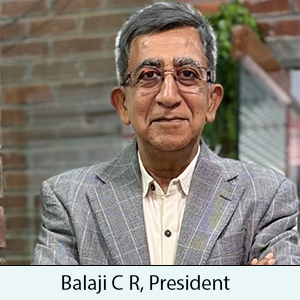
This matters for the AI story. Contineo’s fifteen-year data advantage, the very substrate that makes its production AI possible, exists only because customers stayed for fifteen years. The innovation and the obsession are not two separate virtues; one is the dividend of the other. “In fifteen years, we have never had a salesperson. Every customer came because another customer sent them”, says Balaji C R, President.
 The Right Tool For The Right Job
Computing a mark. Tabulating a grade. Enforcing an ordinance. Moving a fee. These are domains with precisely one correct answer, in which a student’s hard-won result deserves the certainty of arithmetic rather than the shrug of a probability. For all of this, Contineo writes deterministic code - exact, auditable, provably correct every single time.
Artificial intelligence is reserved, deliberately, for the other kind of problem - the kind where even a thoughtful human being can offer only an estimate. Which students are most likely to struggle. Which answer script, which pattern of marks looks anomalous and deserves a second human eye. This is the proper province of AI, and Contineo confines it there with discipline.
“We write deterministic code where the answer must be exact, and use AI only where the honest answer is a probability. Knowing which is which is the whole game”, adds Sudhindra Mokhasi, Founder and CEO.
Innovation, Patent-Pending: The Scriptometer
The clearest expression of Contineo’s applied-AI philosophy sits inside its Digital Valuation System (DVS) - and it is the subject of a pending patent application.
DVS was designed as a presentation layer over Contineo’s proven examination core, built to reduce friction across the assessment chain. It introduced OMR-based capture of the student seat number and course code directly from the answer booklet’s first page, eliminating an entire class of human encoding error. But its signature innovation is the Scriptometer.
The insight behind it is disarmingly simple, and characteristically grounded in observation rather than theory: nearly thirty percent of the average answer booklet is blank pages, and evaluators were spending a meaningful fraction of their time turning through emptiness. The Scriptometer detects those pages automatically and removes them from the evaluation path, presenting the evaluator with a visual map of the script - and cutting valuation time by up to 30 percent, without ever taking the academic judgement out of human hands.
Innovation, In Production: Augmenting Student Outcomes
If the Scriptometer shows Contineo applying AI to institutional efficiency, its student-outcomes work shows it applying AI to the thing that matters most-the student. The goal is deceptively plain: identify, as early as possible, the lowest quartile of students - those most at risk of struggling - so that institutions can intervene while intervention can still change the outcome. The hard part is doing it accurately, and doing it early, when the least information is available.
Contineo built a predictive model and measured it honestly, using recall - the proportion of genuinely at-risk students the model correctly identifies. The results, drawn from real 2019 and 2020 institutional batches, are striking not because they are perfect but because they improve exactly as a trustworthy model should. Even at admission, with nothing but entry data, the model was catching seven in ten of the students who would need help - and within a couple of semesters, nine in ten or better.
The pilot met with “very high interest from customers” and can be deployed today at any institution with at least seven years of data on the platform. “Catching a struggling student at admission, not at the final result - that is what AI is for. Everything else is decoration”, says Aparna Mokhasi, Co-Founder and Director.
Woven through, not Bolted on
These flagship innovations sit within a broader upcoming release - Contineo 2.5 - in which AI is threaded through the everyday work of an institution rather than confined to a headline feature: CIE and SEE analytics, predictive performance indices, student stratification, slow- and advanced-learner identification, and a real-time examination dashboard that exposes bottlenecks as they form.
Through all of it, the evaluator still evaluates, the mentor still mentors, and the institution remains the final academic determinant. What the AI removes is friction, blindness and delay - the blank pages, the late diagnosis, the bottleneck no one could see.
The Road Ahead
Accept that premise and the scale of what lies ahead comes into focus. Every long-tenured Contineo institution sits on something almost no one else in Indian higher education possesses: a System of Record holding up to fifteen years of its own continuous academic truth. Run that record through AI, patiently and responsibly, and it begins to answer questions the sector has not yet learned how to ask.
Which pedagogical interventions actually move outcomes, and which merely feel virtuous. Where examination anomalies hide in plain sight. How an accreditation result might be foreseen years in advance, while there is still time to change it.
The most tangible expression of that future is already taking shape: the Contineo AI Student Portal, which will put the AI prompt directly into the hands of students and faculty. Instead of navigating reports and dashboards, they will simply ask - and behind every plain-language question sits fifteen years of trustworthy records and the same disciplined AI: answering, suggesting, pointing the way, but never adjudicating.
The most valuable thing Contineo ever built was never the software. It was the record - fifteen unbroken years of institutional memory, kept in trust for the institutions that own it, with a discipline that once seemed almost excessive. Artificial intelligence is merely the lens that finally reveals what was latent in it all along. “From category creators, we have evolved to category practitioners - the ones who actually ship the future, not just forecast it”, signs off Sudhindra Mokhasi.
It is an approach consistent with how Contineo has grown over the past fifteen years: quietly, organically, and without a dedicated sales force, relying instead on referrals from institutions that have stayed with the company for years. The story of Contineo, then, is not simply about adopting AI. It is about how one of India’s early academic-autonomy technology pioneers built the data, domain expertise, and institutional trust required to make applied AI genuinely useful in higher education.
The Gap Between the Demo and the Deployment
Inside examination evaluation centres at some of the country’s leading institutions, its AI is already working alongside evaluators. Scriptometer, Contineo’s patent-pending innovation, analyses scanned answer scripts, identifies blank pages that evaluators would otherwise have to navigate manually, and streamlines the valuation process - without interfering with academic judgment.
The same philosophy extends beyond examinations. Drawing on years of structured institutional data, Contineo’s predictive models can identify, as early as the admission stage, students who may be more likely to face academic difficulty. This gives institutions an opportunity to begin mentoring and targeted intervention early - rather than waiting for examination results to reveal that a student is already struggling.
“The real test of AI isn’t what you can demonstrate. It’s what you are willing to run in production, on a real exam, with a real student’s result on the line”, says Sudhindra Mokhasi, Founder & CEO.
A Pattern of Arriving Early Founded by the husband-and-wife team of Sudhindra and Aparna Mokhasi, Contineo did not enter an existing market; it created one. Sudhindra, who formerly headed global technology solutions at Mphasis, and Aparna together built Contineo from first principles as a platform for academic autonomy and Outcome-Based Education - a category that, in Sudhindra’s words, “did not exist when we launched.”
The early-arrival pattern repeated itself. Contineo had Washington Accord-aligned OBE working with KLE Technological University in 2012, two years before outcome-based education became mainstream practice. It chose SaaS delivery long before that was the obvious choice. The result is a company with marquee, long-tenure customers, among them M S Ramaiah Institute of Technology and KLE Tech, and a retention record guarded fiercely across fifteen years. Today, by its own reckoning, Contineo serves roughly two in five of the VTU autonomous institutions it once invented the software for a 40 percent share of a category it created.
Fifteen Years, Not One Salesperson
There is a fact about Contineo that, once heard, reframes everything else about it. In its entire existence, the company has never employed a sales force. There is no sales department, no quota, no pipeline of cold outreach. Every customer it has ever signed arrived the same way: through a referral from another customer.
"Drawing on years of structured institutional data, Contineo’s predictive models can identify, as early as the admission stage, students who may be more likely to face academic difficulty"
This is why Aparna Mokhasi, Co-Founder and Director, of Operations, calls the company customer-obsessed rather than merely customer-centric. Every institution has a designated relationship manager, not just a ticketing queue; retention is near-total, and contracts run not for a year or two but, in the longest cases, for fifteen. Enduring relationships, not campaigns, have carried the brand.
This matters for the AI story. Contineo’s fifteen-year data advantage, the very substrate that makes its production AI possible, exists only because customers stayed for fifteen years. The innovation and the obsession are not two separate virtues; one is the dividend of the other. “In fifteen years, we have never had a salesperson. Every customer came because another customer sent them”, says Balaji C R, President.
The Right Tool For The Right Job Computing a mark. Tabulating a grade. Enforcing an ordinance. Moving a fee. These are domains with precisely one correct answer, in which a student’s hard-won result deserves the certainty of arithmetic rather than the shrug of a probability. For all of this, Contineo writes deterministic code - exact, auditable, provably correct every single time.
Artificial intelligence is reserved, deliberately, for the other kind of problem - the kind where even a thoughtful human being can offer only an estimate. Which students are most likely to struggle. Which answer script, which pattern of marks looks anomalous and deserves a second human eye. This is the proper province of AI, and Contineo confines it there with discipline.
“We write deterministic code where the answer must be exact, and use AI only where the honest answer is a probability. Knowing which is which is the whole game”, adds Sudhindra Mokhasi, Founder and CEO.
Innovation, Patent-Pending: The Scriptometer
The clearest expression of Contineo’s applied-AI philosophy sits inside its Digital Valuation System (DVS) - and it is the subject of a pending patent application.
DVS was designed as a presentation layer over Contineo’s proven examination core, built to reduce friction across the assessment chain. It introduced OMR-based capture of the student seat number and course code directly from the answer booklet’s first page, eliminating an entire class of human encoding error. But its signature innovation is the Scriptometer.
The insight behind it is disarmingly simple, and characteristically grounded in observation rather than theory: nearly thirty percent of the average answer booklet is blank pages, and evaluators were spending a meaningful fraction of their time turning through emptiness. The Scriptometer detects those pages automatically and removes them from the evaluation path, presenting the evaluator with a visual map of the script - and cutting valuation time by up to 30 percent, without ever taking the academic judgement out of human hands.
Innovation, In Production: Augmenting Student Outcomes
If the Scriptometer shows Contineo applying AI to institutional efficiency, its student-outcomes work shows it applying AI to the thing that matters most-the student. The goal is deceptively plain: identify, as early as possible, the lowest quartile of students - those most at risk of struggling - so that institutions can intervene while intervention can still change the outcome. The hard part is doing it accurately, and doing it early, when the least information is available.
Contineo built a predictive model and measured it honestly, using recall - the proportion of genuinely at-risk students the model correctly identifies. The results, drawn from real 2019 and 2020 institutional batches, are striking not because they are perfect but because they improve exactly as a trustworthy model should. Even at admission, with nothing but entry data, the model was catching seven in ten of the students who would need help - and within a couple of semesters, nine in ten or better.
The pilot met with “very high interest from customers” and can be deployed today at any institution with at least seven years of data on the platform. “Catching a struggling student at admission, not at the final result - that is what AI is for. Everything else is decoration”, says Aparna Mokhasi, Co-Founder and Director.
Woven through, not Bolted on
These flagship innovations sit within a broader upcoming release - Contineo 2.5 - in which AI is threaded through the everyday work of an institution rather than confined to a headline feature: CIE and SEE analytics, predictive performance indices, student stratification, slow- and advanced-learner identification, and a real-time examination dashboard that exposes bottlenecks as they form.
Through all of it, the evaluator still evaluates, the mentor still mentors, and the institution remains the final academic determinant. What the AI removes is friction, blindness and delay - the blank pages, the late diagnosis, the bottleneck no one could see.
The Road Ahead
Accept that premise and the scale of what lies ahead comes into focus. Every long-tenured Contineo institution sits on something almost no one else in Indian higher education possesses: a System of Record holding up to fifteen years of its own continuous academic truth. Run that record through AI, patiently and responsibly, and it begins to answer questions the sector has not yet learned how to ask.
Which pedagogical interventions actually move outcomes, and which merely feel virtuous. Where examination anomalies hide in plain sight. How an accreditation result might be foreseen years in advance, while there is still time to change it.
The most tangible expression of that future is already taking shape: the Contineo AI Student Portal, which will put the AI prompt directly into the hands of students and faculty. Instead of navigating reports and dashboards, they will simply ask - and behind every plain-language question sits fifteen years of trustworthy records and the same disciplined AI: answering, suggesting, pointing the way, but never adjudicating.
The most valuable thing Contineo ever built was never the software. It was the record - fifteen unbroken years of institutional memory, kept in trust for the institutions that own it, with a discipline that once seemed almost excessive. Artificial intelligence is merely the lens that finally reveals what was latent in it all along. “From category creators, we have evolved to category practitioners - the ones who actually ship the future, not just forecast it”, signs off Sudhindra Mokhasi.
Current Issue