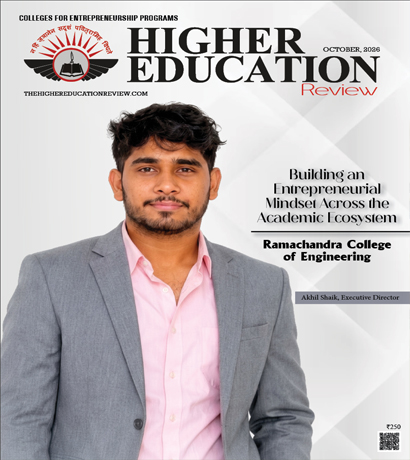
Ramachandra College of Engineering: Building an Entrepreneurial Mindset across the Academic Ecosystem

Akhil Shaik, Executive Director, Ramachandra College of Engineering
As higher education evolves beyond conventional degree-based learning, colleges are increasingly recognising entrepreneurship as an important dimension of engineering education. Institutions are moving beyond standalone entrepreneurship courses to create environments where students can identify opportunities, experiment with ideas, engage with industry and understand how technical knowledge can translate into viable businesses. Ramachandra College of Engineering (RCE), Eluru, is shaping such an ecosystem by placing entrepreneurship, innovation and practical problem-solving alongside its academic programmes.
The autonomous institution offers B.Tech, M.Tech, MBA and BBA programmes, with industry interface, research and innovation forming important elements of its academic environment. Rather than treating entrepreneurship as an occasional activity, RCE is working to introduce an entrepreneurial perspective across disciplines, encouraging students to view technical education not only as preparation for employment, but also as a foundation for creating solutions, ventures and jobs.
From Job Seekers to Job Creators
At the centre of this transition is a change in how students are encouraged to perceive their education. Akhil Shaik, Executive Director, Ramachandra College of Engineering, brings experience across multinational corporations and startups, along with his own exposure to entrepreneurship. After completing his MBA and spending five years in a managerial role at Tata Consultancy Services, he moved into the startup ecosystem before joining RCE.
Since taking up his role, one of his priorities has been to strengthen entrepreneurship across the institution. Instead of presenting it as something relevant primarily to management students, RCE encourages engineering students to consider how their technical knowledge could become the basis for a business.
Faculty members are consequently encouraged to connect classroom concepts with market opportunities, industry requirements and potential business models. A student studying an engineering technology, for instance, can be prompted to examine gaps within that sector, identify possible solutions and determine whether those solutions could become viable ventures.
“This approach also changes the language of education. Instead of telling students that a particular skill will help them secure a job, the institution seeks to demonstrate how the same skill could enable them to create a business and generate employment for others”, says Akhil Shaik, Executive Director.
Extending this philosophy beyond the campus, Akhil has conceptualised Corporate Innovation Responsibility (CIR) , an original framework developed in 2026 that explores how corporations can participate more systematically in startup development. CIR proposes moving corporate engagement with innovation beyond conventional sponsorship towards strategic investment, ecosystem support, employment generation and knowledge transfer. The thinking complements RCE’s larger objective of creating graduates who can become enterprise and employment creators.
"RCE's larger aspiration is to make entrepreneurship a natural extension of learning rather than an optional pursuit"
Embedding Entrepreneurship into Every Discipline
RCE’s autonomous status provides flexibility to integrate such thinking into its academic framework. The institution is working towards making entrepreneurship a layer within individual courses rather than confining it to one specialised subject. This is particularly relevant in engineering, where students may possess strong technical capabilities but have limited exposure to customer validation, market opportunities and business creation.
For example, students exploring electric-vehicle technologies can examine the sector’s future requirements, identify unresolved problems and study gaps capable of generating new business opportunities. Similar thinking can be applied across engineering disciplines, helping students develop an entrepreneurial lens alongside technical competence.
The emphasis is also on participation and accountability. Students are encouraged to generate ideas and consider their practical applications instead of attending entrepreneurship programmes passively. Whether every idea becomes a company is secondary to developing the ability to identify problems, formulate solutions and test assumptions.
The institution complements this academic integration through hackathons, entrepreneurship challenges, research and development activities, industrial visits and student clubs.
RCE is simultaneously expanding its external innovation linkages. Its MoU with the Ratan Tata Innovation Hub (RTIH) represents another step towards connecting the campus with the wider innovation and startup ecosystem. Such institutional collaborations are intended to create stronger pathways through which students can gain exposure, mentorship and ecosystem support while taking promising ideas beyond the classroom.
Connecting Ideas with Industry, Capital & Knowledge
An entrepreneurial idea becomes meaningful when it encounters the realities of customers, technology, capital and execution. RCE is therefore strengthening the industry and mentorship dimension of its ecosystem. The college has partnered with a state-run incubation centre, through which experts conduct regular sessions with students. Entrepreneurs and industry professionals are also invited to the campus, enabling students to hear directly about market requirements and the challenges involved in building businesses.
The institution also facilitates individual connections when an idea requires specialised guidance. A student developing an AI-based healthcare assistant, for instance, may need inputs from healthcare professionals alongside technical experts. RCE’s approach is to help students access relevant networks and mentorship rather than leaving them to navigate those requirements alone.
Funding forms another part of this support structure. The institution has been pursuing MSME funding for student projects over several years, while its leadership emphasises investment in promising student ideas instead of automatically directing successful students towards jobs. Even modest support, it believes, can encourage students to think more seriously about entrepreneurship.
This philosophy finds a broader expression in Akhil’s CIR-4 Framework, which is structured around four proposed pillars: Financial Investment Responsibility, Ecosystem Development Responsibility, Employment Generation Responsibility and Knowledge Transfer Responsibility. The framework proposes
that corporate participation in startups should extend beyond capital to include market access, infrastructure, mentorship, operational expertise, technology and professional networks.
At its core, CIR proposes a model in which corporate involvement can create value for multiple stakeholders. Its Financial Investment Responsibility pillar proposes strategic equity investment in startups, while Ecosystem Development Responsibility focuses on enabling access to corporate supply chains, customer networks, pilot opportunities and other business infrastructure.
Employment Generation Responsibility places measurable job creation at the centre of startup support, while Knowledge Transfer Responsibility emphasises sharing corporate expertise, technology, operational systems and networks with emerging ventures.
The framework further proposes mechanisms for measuring outcomes through indicators such as startups funded, jobs created, vendor relationships established, mentorship hours delivered and technologies shared. CIR remains a proposed framework rather than an established corporate or regulatory requirement, but its underlying principle closely aligns with RCE’s educational direction: innovation becomes more consequential when ideas are connected with the capital, knowledge and ecosystems necessary to scale them.
RCE’s campus ecosystem also extends beyond enrolled students. It has established a co-working space that entrepreneurs from the surrounding community can use in a plug-and-play environment, opening the institution to Eluru’s wider entrepreneurial community while giving students the opportunities to interact with entrepreneurs outside formal academic settings.
Turning Learning into Enterprise
Practical learning reinforces this entrepreneurship philosophy. In management education, students undertaking an Entrepreneurship Development Programme are expected to develop projects and experience the process of establishing a proprietorship, completing MSME registration and selling products or services. Rather than relying entirely on conventional written examinations, the exercise exposes students to practical realities ranging from registration to customer acquisition.
A similar application-oriented approach is visible in portfolio management, where students create live demat accounts and engage with stock-market investing. The emphasis is consistently on moving learning from theoretical understanding towards execution.
In April 2026, RCE hosted Prakalp 2K26, a national-level project expo and 24-hour hackathon featuring 100-plus project slots, 200 hackathon teams, industry mentorship and a ₹3 lakh prize pool. Earlier, it’s Startup Synergy: Fostering Entrepreneurship through Innovation programme brought MBA and engineering students together to explore startups, business opportunities and government support for entrepreneurs.
“Such initiatives provide students with an environment in which ideas can be presented, challenged and improved. They also make innovation a visible part of campus culture rather than an activity restricted to a small group of students”, speaks Akhil Shaik.
Building a Long-Term Entrepreneurial Ecosystem
RCE now wants entrepreneurial outcomes to become an important measure of institutional success. Its leadership envisions evaluating the college not only through graduates, degrees and conventional placements, but also through ventures created, employment generated and value produced by its students.
As Akhil Shaik puts it, “I don’t measure this institution’s success by degrees awarded, but by the number of students who leave here ready to create - create jobs, create ventures, create value. That’s the only education that truly compounds.”
Over the next five years, the institution aims to increase the proportion of students who eventually work in businesses created by fellow students, while strengthening entrepreneurship across courses and expanding corporate participation in innovation.
CIR could become one of the conceptual bridges supporting this ambition. Akhil’s framework ultimately envisions corporations participating not merely as recruiters or sponsors, but as investors, customers, mentors and innovation partners. Such engagement could give student entrepreneurs access to capabilities that educational institutions alone may not be able to provide and help promising projects progress from prototypes towards commercially sustainable ventures.
For RCE, therefore, building an entrepreneurial institution is not simply about increasing the number of startup workshops or competitions. It is about connecting education, incubation, industry, capital and knowledge into a more continuous pathway. Through academic integration, practical experimentation, collaborations such as RTIH and the broader thinking represented by CIR, the institution is working towards an ecosystem where entrepreneurship becomes a credible outcome of engineering education.
RCE’s larger aspiration is to make entrepreneurship a natural extension of learning rather than an optional pursuit. By connecting technical education with industry exposure, mentorship, experimentation and venture creation, it seeks to produce graduates capable of participating in the economy not only as skilled professionals, but also as innovators and job creators.
Current Issue