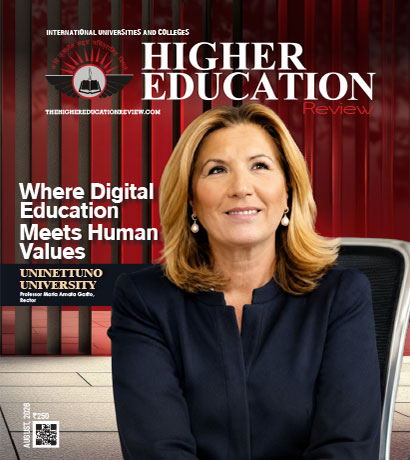
UNINETTUNO University: Where Digital Education Meets Human Values

Professor Maria Amata Garito, Rector, UNINETTUNO University
Higher education is entering one of its most defining chapters. Universities across the world are no longer evaluated solely by centuries-old legacies, impressive campuses, or academic rankings.
They are increasingly measured by their ability to expand access to quality education, foster international collaboration, embrace technological innovation responsibly, and prepare learners for a world shaped by constant change.
As artificial intelligence, digital learning, and lifelong education redefine academic institutions, the challenge is no longer simply adopting technology; it is ensuring that technology enhances learning rather than diminishes it.
Italy has long been recognised for its contribution to global scholarship, but it is also home to institutions that have quietly redefined how universities can operate in the digital age. Among them is the International Telematic University UNINETTUNO, recognised among the “Top Universities from Italy”.
Unlike many institutions that embraced online education only in recent years, UNINETTUNO represents the culmination of more than three decades of scientific research into educational technologies, psycho-pedagogy, and international cooperation. Today, with students from 167 countries and academic collaborations spanning continents, the university has become an international reference point for digitally enabled higher education.
Driving this vision is Professor Maria Amata Garito, Rector of International Telematic University UNINETTUNO, whose pioneering work has shaped not only the University's philosophy but also the broader conversation surrounding the future of digital education.
For Professor Garito, technology has never been the destination. It has always been the means to achieve something far greater, a university where knowledge transcends geographical borders while preserving academic excellence, human relationships, and intellectual curiosity.
A New Model of Higher Education
The widespread adoption of digital education has often created the impression that online universities are a recent phenomenon. Professor Garito challenges that assumption by reminding us that meaningful innovation begins with research, not circumstance.
The foundations of UNINETTUNO can be traced back to the NETTUNO Consortium, established in 1992 through the collaboration of 41 Italian public universities, 31 international universities, and leading industrial and technological organisations. The initiative sought to answer a question that remains highly relevant today: how can technology expand access to higher education without compromising academic quality?
"When we first envisioned a new kind of university capable of overcoming the barriers of space and time, many believed it was an overly ambitious dream," Professor Garito recalls. "We believed that technology could open access to knowledge for everyone without ever compromising academic quality, scientific rigour or the human relationship between professors and students."
That vision ultimately evolved into International Telematic University UNINETTUNO, not simply as an online institution, but as a scientifically designed educational model rooted in psycho-pedagogical research. Every aspect of the University's learning ecosystem was developed to ensure that digital education remained academically rigorous, interactive, and deeply human.
"UNINETTUNO has always been much more than an online university," she explains. "It is an international university, a global community of knowledge where different cultures meet and where technology is placed at the service of people."
"UNINETTUNO represents the culmination of more than three decades of scientific research into educational technologies, psycho-pedagogy, and international cooperation"
Building a Global Classroom Without Borders
Professor Garito has long believed that universities should serve as places where cultures meet, ideas evolve, and international dialogue flourishes. That philosophy is reflected in UNINETTUNO's remarkably diverse academic community, where students from 167 countries learn within the same educational environment.
Rather than viewing internationalisation as an institutional objective, the University has embedded it into its academic model. Learners engage with different cultures, perspectives, and experiences throughout their educational journey, preparing them for increasingly interconnected professional environments.
Supporting this vision is an extensive network of collaborations with universities and institutions across Europe, the Mediterranean, Africa, the Arab world, the United States, and several other regions.
According to Dr. Nicola Paravati, Head of International Affairs and Development, these partnerships have strengthened the university's global presence through dual-degree programmes, joint curricula, Erasmus initiatives, virtual mobility projects, and collaborative research, enabling students to benefit from an increasingly interconnected international academic ecosystem.
For Professor Garito, however, the university's international character extends beyond partnerships or student numbers. "Knowledge should never be the privilege of a few," she says. "It should be a fundamental right, accessible to everyone, everywhere in the world."
This philosophy has enabled UNINETTUNO to open higher education to working professionals, students in remote regions, migrants, refugees, and learners whose personal or geographical circumstances might otherwise have prevented them from pursuing a university education.
When Technology Becomes a Tool for Thinking
While digital transformation continues to dominate conversations across higher education, Professor Garito believes that technology must always remain subordinate to pedagogy. "Technology can become a powerful instrument for democratising knowledge," she explains, "but only when it is grounded in a rigorous psycho-pedagogical model, high-quality educational content and a strong sense of ethical responsibility."
This principle has guided the development of UNINETTUNO's proprietary technological platform, which integrates video lectures, virtual classrooms, digital libraries, discussion forums, virtual laboratories, practical exercises, and continuous tutoring within a single academic environment. Rather than simply delivering content, the platform has been designed to encourage critical thinking, collaboration, and active participation.
Equally significant is the university's commitment to ensuring that students remain connected to professors, tutors, and fellow learners throughout their academic journey. "For us, technology should never isolate students," Professor Garito says. "Physical distance must never become cultural or human distance."
That same philosophy shapes UNINETTUNO's approach to artificial intelligence. Rather than viewing AI as a shortcut to knowledge, the university has developed Socrates AI, inspired by the Socratic method and designed to stimulate reasoning rather than passive information retrieval.
"Our goal is to help students learn to reason rather than simply reproduce information; to develop critical thinking rather than technological dependence," Professor Garito explains. "AI should never replace professors or students' intellectual effort. It should strengthen human intelligence."
A Manifesto for the University of the Future
For Professor Maria Amata Garito, the future of higher education will not be determined by technology alone. It will depend upon whether universities remain faithful to their fundamental purpose: cultivating knowledge, encouraging critical thought, and preparing individuals to contribute meaningfully to society.
This conviction has shaped UNINETTUNO's evolution for more than thirty years. Its academic programmes continue to combine disciplinary expertise with transferable skills such as analytical thinking, problem-solving, communication, digital literacy, intercultural awareness, and lifelong learning - qualities that have become indispensable in an increasingly dynamic global economy.
As universities continue adapting to artificial intelligence, digital transformation, and changing learner expectations, Professor Garito believes institutions must remain guided by humanistic values rather than technological trends.
"The university of the future must be technologically advanced yet profoundly human; international in outlook yet uncompromising in quality; flexible yet academically rigorous; innovative yet always guided by ethics and the values of humanism," she says.
That philosophy has positioned International Telematic University UNINETTUNO not simply as a pioneer of digital education, but as a university that anticipated many of the changes now reshaping higher education worldwide. More importantly, it demonstrates that the true measure of innovation is not how effectively technology replaces traditional learning, but how successfully it expands opportunity, strengthens human intelligence, and builds bridges between cultures through the universal language of knowledge.
UNINETTUNO | AT A GLANCE
• Founded on over 30 years of pioneering educational research.
• Students from 167 countries study through its global learning ecosystem.
• Built on a proprietary psycho-pedagogical learning model.
• International collaborations spanning Europe, Africa, and the Mediterranean.
• Advancing ethical AI in education through Socrates AI.
They are increasingly measured by their ability to expand access to quality education, foster international collaboration, embrace technological innovation responsibly, and prepare learners for a world shaped by constant change.
As artificial intelligence, digital learning, and lifelong education redefine academic institutions, the challenge is no longer simply adopting technology; it is ensuring that technology enhances learning rather than diminishes it.
Italy has long been recognised for its contribution to global scholarship, but it is also home to institutions that have quietly redefined how universities can operate in the digital age. Among them is the International Telematic University UNINETTUNO, recognised among the “Top Universities from Italy”.
Unlike many institutions that embraced online education only in recent years, UNINETTUNO represents the culmination of more than three decades of scientific research into educational technologies, psycho-pedagogy, and international cooperation. Today, with students from 167 countries and academic collaborations spanning continents, the university has become an international reference point for digitally enabled higher education.
Driving this vision is Professor Maria Amata Garito, Rector of International Telematic University UNINETTUNO, whose pioneering work has shaped not only the University's philosophy but also the broader conversation surrounding the future of digital education.
For Professor Garito, technology has never been the destination. It has always been the means to achieve something far greater, a university where knowledge transcends geographical borders while preserving academic excellence, human relationships, and intellectual curiosity.
A New Model of Higher Education
The widespread adoption of digital education has often created the impression that online universities are a recent phenomenon. Professor Garito challenges that assumption by reminding us that meaningful innovation begins with research, not circumstance.
The foundations of UNINETTUNO can be traced back to the NETTUNO Consortium, established in 1992 through the collaboration of 41 Italian public universities, 31 international universities, and leading industrial and technological organisations. The initiative sought to answer a question that remains highly relevant today: how can technology expand access to higher education without compromising academic quality?
"When we first envisioned a new kind of university capable of overcoming the barriers of space and time, many believed it was an overly ambitious dream," Professor Garito recalls. "We believed that technology could open access to knowledge for everyone without ever compromising academic quality, scientific rigour or the human relationship between professors and students."
That vision ultimately evolved into International Telematic University UNINETTUNO, not simply as an online institution, but as a scientifically designed educational model rooted in psycho-pedagogical research. Every aspect of the University's learning ecosystem was developed to ensure that digital education remained academically rigorous, interactive, and deeply human.
"UNINETTUNO has always been much more than an online university," she explains. "It is an international university, a global community of knowledge where different cultures meet and where technology is placed at the service of people."
"UNINETTUNO represents the culmination of more than three decades of scientific research into educational technologies, psycho-pedagogy, and international cooperation"
Building a Global Classroom Without Borders
Professor Garito has long believed that universities should serve as places where cultures meet, ideas evolve, and international dialogue flourishes. That philosophy is reflected in UNINETTUNO's remarkably diverse academic community, where students from 167 countries learn within the same educational environment.
Rather than viewing internationalisation as an institutional objective, the University has embedded it into its academic model. Learners engage with different cultures, perspectives, and experiences throughout their educational journey, preparing them for increasingly interconnected professional environments.
Supporting this vision is an extensive network of collaborations with universities and institutions across Europe, the Mediterranean, Africa, the Arab world, the United States, and several other regions.
According to Dr. Nicola Paravati, Head of International Affairs and Development, these partnerships have strengthened the university's global presence through dual-degree programmes, joint curricula, Erasmus initiatives, virtual mobility projects, and collaborative research, enabling students to benefit from an increasingly interconnected international academic ecosystem.
For Professor Garito, however, the university's international character extends beyond partnerships or student numbers. "Knowledge should never be the privilege of a few," she says. "It should be a fundamental right, accessible to everyone, everywhere in the world."
This philosophy has enabled UNINETTUNO to open higher education to working professionals, students in remote regions, migrants, refugees, and learners whose personal or geographical circumstances might otherwise have prevented them from pursuing a university education.
When Technology Becomes a Tool for Thinking
While digital transformation continues to dominate conversations across higher education, Professor Garito believes that technology must always remain subordinate to pedagogy. "Technology can become a powerful instrument for democratising knowledge," she explains, "but only when it is grounded in a rigorous psycho-pedagogical model, high-quality educational content and a strong sense of ethical responsibility."
This principle has guided the development of UNINETTUNO's proprietary technological platform, which integrates video lectures, virtual classrooms, digital libraries, discussion forums, virtual laboratories, practical exercises, and continuous tutoring within a single academic environment. Rather than simply delivering content, the platform has been designed to encourage critical thinking, collaboration, and active participation.
Equally significant is the university's commitment to ensuring that students remain connected to professors, tutors, and fellow learners throughout their academic journey. "For us, technology should never isolate students," Professor Garito says. "Physical distance must never become cultural or human distance."
That same philosophy shapes UNINETTUNO's approach to artificial intelligence. Rather than viewing AI as a shortcut to knowledge, the university has developed Socrates AI, inspired by the Socratic method and designed to stimulate reasoning rather than passive information retrieval.
"Our goal is to help students learn to reason rather than simply reproduce information; to develop critical thinking rather than technological dependence," Professor Garito explains. "AI should never replace professors or students' intellectual effort. It should strengthen human intelligence."
A Manifesto for the University of the Future
For Professor Maria Amata Garito, the future of higher education will not be determined by technology alone. It will depend upon whether universities remain faithful to their fundamental purpose: cultivating knowledge, encouraging critical thought, and preparing individuals to contribute meaningfully to society.
This conviction has shaped UNINETTUNO's evolution for more than thirty years. Its academic programmes continue to combine disciplinary expertise with transferable skills such as analytical thinking, problem-solving, communication, digital literacy, intercultural awareness, and lifelong learning - qualities that have become indispensable in an increasingly dynamic global economy.
As universities continue adapting to artificial intelligence, digital transformation, and changing learner expectations, Professor Garito believes institutions must remain guided by humanistic values rather than technological trends.
"The university of the future must be technologically advanced yet profoundly human; international in outlook yet uncompromising in quality; flexible yet academically rigorous; innovative yet always guided by ethics and the values of humanism," she says.
That philosophy has positioned International Telematic University UNINETTUNO not simply as a pioneer of digital education, but as a university that anticipated many of the changes now reshaping higher education worldwide. More importantly, it demonstrates that the true measure of innovation is not how effectively technology replaces traditional learning, but how successfully it expands opportunity, strengthens human intelligence, and builds bridges between cultures through the universal language of knowledge.
UNINETTUNO | AT A GLANCE
• Founded on over 30 years of pioneering educational research.
• Students from 167 countries study through its global learning ecosystem.
• Built on a proprietary psycho-pedagogical learning model.
• International collaborations spanning Europe, Africa, and the Mediterranean.
• Advancing ethical AI in education through Socrates AI.
Current Issue