
Delhi Office Space Rent Trends 2026: Is Central Delhi Still Worth It?
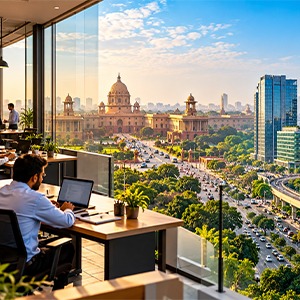 Ask any broker in the capital where rents are heading, and the answer usually comes with a question attached: worth it compared to what? Delhi's office market has split into two distinct stories. One is the old guard, built on decades of brand recognition and institutional proximity. The other is newer, faster-growing, and increasingly hard to ignore. Choosing between them used to come down to rent alone. Now it comes down to what a company needs from its address - team size, client profile, travel patterns, and how fast the business plans to scale.
That shift is being driven from outside Delhi as much as from within it. Global Capability Centres and multinational occupiers are expanding their NCR footprint, and their leasing decisions look nothing like the ones a domestic law firm or trading house made a decade ago. They're less loyal to a single neighbourhood's prestige and more focused on infrastructure, talent access, and how fast they can get a floor operational. That single change in who's leasing has quietly rewritten the rules for both Central Delhi and its newer rivals.
The Case for Central Delhi
No newer commercial hub has replicated what Connaught Place offers on paper: proximity to government buildings, embassies, and courts that some businesses simply can't operate without. Metro connectivity is excellent, and the area's colonial-era architecture still photographs well for a corporate identity. For law firms, consulting practices, and legacy financial institutions, this address remains a genuine asset - not a nostalgic one.
The catch is space itself. Floor plates here are smaller and harder to expand than what newer developments offer, which caps how much a growing team can scale without relocating. Renovation timelines also run longer in heritage buildings, many of which carry restrictions on what can be modified. For a company planning to double headcount in eighteen months, that's a real constraint, not a footnote.
The Pull Toward Aerocity
Office space in Aerocity has become the default choice for firms that want a modern campus without leaving Delhi altogether. The appeal starts with the airport: for any company running frequent international travel or client visits, cutting the commute from "half the day" to "a short ride" changes how meetings get scheduled, not just how they feel.
Most buildings here were built within the last decade, so the infrastructure and floor plates skew larger and more flexible than what Central Delhi can offer. Hotels, restaurants, and retail are woven between the corporate towers, giving employees more to do on a lunch break than older commercial pockets ever could. None of that shows up on a rent sheet, but it shows up in how easy the address is to sell to both clients and candidates.
What Tenants Should Actually Weigh
Rent per square foot rarely tells the whole story. When evaluating office space in Delhi, a company should map out realistic commute times for its current workforce - an inconvenient address can push attrition up enough to erase whatever was saved on the headline rent. Parking matters more in Central Delhi, where dedicated multilevel structures are the norm, than in Aerocity or other newer corridors. Fit-out timelines matter too: heritage buildings typically take longer to modify than towers built with flexible floor plates from the start.
None of this show up in a simple rent comparison, but together they often move the total cost of occupancy more than the lease rate itself does.
Why Managed Offices Are Changing the Equation
A third factor is reshaping this comparison entirely. Managed office formats have grown rapidly across both older and newer Delhi business districts, and that growth is changing how companies think about location altogether. Instead of signing a bare-shell lease and spending months on fit-out, a growing share of tenants now walks into a furnished floor and start operating within weeks.
That matters most in Central Delhi, where available space is scarce and desirable leases are hard to come by - a managed format sidesteps the renovation bottleneck entirely. It matters in Aerocity too, where shorter lease terms let companies test the market before committing long-term. Managed providers typically fold maintenance, connectivity, and furnishings into one monthly line, removing much of the operational overhead that used to make Central Delhi feel impractical for a fast-growing team.
So, Is Central Delhi Still Worth It?
Central Delhi still holds an edge that newer corridors haven't replicated: institutional proximity, heritage, and a level of brand recognition that Aerocity is still building toward. Aerocity, in turn, wins on the things that increasingly matter to a scaling, globally connected team - flexibility, modern infrastructure, and airport access that shortens the distance between Delhi and the rest of the world.
The gap between the two used to force a binary choice: prestige or pragmatism. Managed office formats operating across both corridors have softened that trade-off considerably. Companies searching for office space in Delhi this year are less likely to pick one address over the other outright - most are asking which trade-off suits their business at its current stage and revisiting that answer as the team grows.
Current Issue