
How Vessel Shape Influences Mixing, Heat Transfer and Reaction Performance
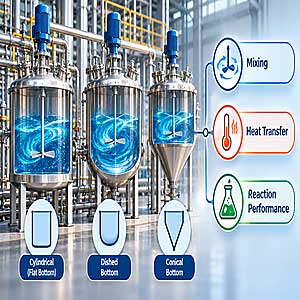 Vessel geometry shapes how a reaction behaves long before any chemistry starts. Shape decides how contents mix and how fast heat moves through the wall. It also sets how safely the vessel handles pressure or vacuum.
Glass process plants use spherical vessels and cylindrical designs. Each shape brings distinct strengths for mixing, heating and scale-up.
The choice depends on the process requirements, vessel capacity and the need for temperature control.
Why Vessel Geometry Matters in Process Design
Surface area and wall stress change with shape. A sphere holds the most volume for the least surface. A cylinder offers more wall area for the same volume.
Wall area controls heat exchange with the surroundings. Wall stress sets safe pressure and vacuum limits. Process teams weigh both when selecting a vessel.
The vessel's shape also affects the space available for internal components. These may include stirrers, baffles, nozzles and other process connections. The selected design must accommodate the required equipment and operating conditions.
Spherical Vessels: Strength and Versatility
A sphere spreads internal and external pressure evenly across its wall. This makes round vessels a strong choice for vacuum duty in glass process plants.
Manufacturers such as Goel Scientific Glass Works Ltd. offer spherical vessels in borosilicate glass 3.3, commonly in 5, 20 and 200 litre sizes, along with custom capacities. Operating conditions range from vacuum to moderate pressure, depending on the customer’s process requirements. Additional equatorial nozzles and dip pipes are available on request.
Cylindrical Vessels: Heat Transfer Area and Scalability
A cylindrical glass vessel offers a larger wall area per litre than a sphere of equal volume. These vessels can be fitted with metal or glass jackets for heating and cooling. Jacketed versions suit processes that need tight temperature control.
Their form suits jackets, baffles, stirrers and other internals. Port and flange configurations can be customised per drawing. Large cylinders need proper support for safe operation.
How Shape Affects Mixing
Vessel shape affects mixing in several ways:
- Spherical Design: The spherical design supports optimal mixing, as listed among the product's key features.
- Internals: The cylindrical form simplifies the design of baffles, stirrers and other internals.
- Integration: Spherical vessels can integrate dip pipes, internal spargers or multiple nozzles.
Baffles, stirrers and other internals can then be added to suit each process. The required arrangement depends on the material being processed and the intended mixing operation. The vessel configuration should allow the necessary components to fit without obstructing process connections.
How Shape Affects Heat Transfer
Heat transfer area grows more slowly than volume as vessels get larger. For geometrically similar vessels, a tenfold increase in volume raises wall area only about 4.6 times. Large vessels therefore heat and cool more slowly per litre. Glass also conducts heat less readily than steel.
Cylinders recover some of this loss through full-height jackets. Jacket circulation then removes reaction heat steadily. Metal or glass jackets can support heating and cooling through circulating thermal fluids. Spheres rely more on heating mantles or baths, which surround the curved wall evenly. Controlled heating rates protect glass from thermal shock. Exothermic reactions need careful heat removal planning in either shape.
Impact on Reaction Performance and Scale-Up
Shape affects reaction results through temperature control and mixing quality. Slow heat removal can cause hot spots, side reactions and lower yields. Uneven mixing creates local concentration gradients and variable product quality. Both effects grow as batch size increases from pilot to plant.
Scale-up works best when teams keep geometric similarity between pilot and production vessels. Matching shape, impeller type and height-to-diameter ratio keeps mixing and heat transfer predictable. Temperature probes at several heights then confirm uniform conditions during commissioning and early batches.
The available vessel configurations also influence how easily a process can move between scales. Spherical vessels can include custom ports and dip pipes. Cylindrical designs can accommodate jackets, baffles and stirrers. These options help align vessel construction with the process layout.
Comparing Spherical and Cylindrical Designs
The two shapes compare as follows:
|
Factor |
Sphere |
Cylinder |
|
Pressure and vacuum strength |
Highest for its volume |
Good with suitable wall thickness |
|
Heat transfer area per litre |
Lower |
Higher |
|
Drainage |
Single low point |
Depends on base design |
|
Scale-up |
Limited by sphere size |
Flexible through height |
|
Typical uses |
Reactions, receivers and vacuum duty |
Jacketed reactions, storage and settling |
Manufacturers such as Goel Scientific Glass Works Ltd. offer cylindrical models from 5 to 500 litres alongside spherical vessels in 5, 20 and 200 litre capacities, including jacketed versions with double-wall construction.
Conclusion
Vessel shape influences mixing, heat transfer and safe operating limits. Spheres offer strength, even stress distribution and reliable vacuum performance. Cylinders offer more heat transfer area and easier integration of jackets and internals. Glass construction adds visual access to the vessel contents.
The best choice depends on reaction heat, pressure duty and target scale.
Current Issue