How Hybrid Degrees are Shaping Global Learning
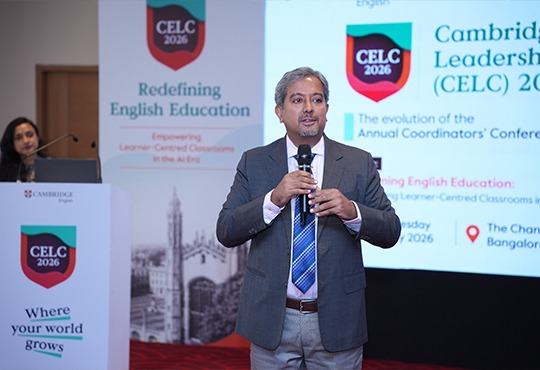 Arunachalam TK, Country Head - English, South Asia, Cambridge University Press & Assessment in an interaction with Janifha Evangeline. X, shares his views on the fundamental changes that schools need to make to ensure learners are prepared not just academically, but for the future workplace as AI is transforming the way students learn, how schools can move beyond teaching English as a subject and instead develop it as a life skill that supports higher education, employability, and global mobility and more.
As AI transforms the way students learn, what fundamental changes do schools need to make to ensure learners are prepared not just academically, but for the future workplace?
Schools need to shift their focus from simply delivering knowledge to developing the capabilities that enable learners to apply, communicate, and create knowledge effectively.
Academic achievement will always remain important, but future success will increasingly depend on how well students can interpret information, articulate ideas, collaborate with others, and adapt to new contexts. In this environment, strong language and communication skills become foundational to both learning and employability and a school sets the grounds for both.
For this, one of the most important changes schools need to make is to move beyond treating English as a standalone subject and recognise it as a core skill that underpins learning across the curriculum.
Listening, speaking, reading and writing are not only language competencies; they are the tools through which students engage with content, build understanding, ask questions, analyse information, and share ideas. Strong LSRW skills enable learners to participate more confidently in classroom discussions, comprehend complex texts, conduct research, and express their thinking with clarity. As learning becomes increasingly inquiry-driven and technology-enabled, these skills will play an even greater role in student success.
Schools also need to create richer opportunities for authentic communication. Rather than focusing predominantly on examination performance, learners should regularly engage in presentations, debates, collaborative projects, discussions, reflective writing, and problem-solving activities. These experiences help students develop confidence, fluency, and the ability to communicate with purpose - qualities that are essential for higher education and professional environments alike.
The connection between English proficiency and university readiness is equally important. Whether students pursue higher education in India or abroad, they are expected to read critically, evaluate sources, participate in academic discourse, and communicate effectively in both written and spoken formats. A strong foundation in English equips learners to navigate these demands more successfully and engage confidently with increasingly global learning environments.
From an employability perspective, communication remains one of the most sought-after professional skills across industries. Employers consistently value individuals who can work effectively in teams, present ideas persuasively, engage with clients and stakeholders, and collaborate across cultures and geographies. As AI takes over more task-based functions, these distinctly human capabilities will become even more valuable.
Ultimately, schools need to create learning environments where language is actively used to explore ideas, solve problems, and engage with the wider world.
Communication skills are increasingly being discussed alongside technical skills. Why are educators placing renewed emphasis on English proficiency in an AI-driven world?
The growing focus on English proficiency in an AI-driven world may appear counterintuitive at first, particularly when technology promises to automate communication tasks. However, educators increasingly recognise that as AI simplifies access to information, the ability to communicate ideas persuasively and professionally becomes even more critical. Technical expertise alone is no longer sufficient; success in higher education and the workplace depends significantly on how effectively individuals can express, interpret, and exchange knowledge.
The rise of AI further reinforces the importance of communication. AI tools are only as effective as the instructions provided to them. Whether students are using generative AI for research, analysis, coding, content creation, or problem-solving, they need the ability to formulate precise questions, evaluate responses critically, and communicate intent clearly. Strong language skills enhance a learner's ability to interact productively with emerging technologies and extract meaningful value from them.
Moreover, while AI can support writing and translation, it cannot fully replace human judgment, context, cultural understanding, persuasion, or authentic interpersonal communication. Professional success often depends on negotiating ideas, presenting solutions, leading teams, building relationships, and influencing stakeholders. These activities require nuanced communication skills that extend beyond grammar and vocabulary.
Educators increasingly view English proficiency as a multiplier skill - one that strengthens learning across subjects, enables more effective engagement with technology, and prepares learners to participate confidently in a globally connected economy.
As workplaces become more global, hybrid, and technology-enabled, the ability to articulate ideas clearly and collaborate across cultures may become one of the most valuable human advantages. In many respects, the future belongs not only to those who can use technology, but also to those who can communicate meaningfully through it.
Also Read: Eligibility Criteria for Artificial Intelligence and Machine Learning Courses in India
Many students believe English is essential for employment, yet a significant number lack confidence in their language skills. What does this disconnect tell us about India's education system?
The fact that many students recognise the importance of English for future employment reflects how rapidly the demands of higher education and the workplace are changing. As aspirations become increasingly global and career pathways more diverse, students are becoming more aware of the role communication skills play in unlocking opportunities.
Over the past decade, India's education landscape has made significant progress in expanding access to English learning across schools and regions. At the same time, expectations around language proficiency have also broadened. Employers and universities today are not only looking for grammatical accuracy or examination performance; they increasingly value the ability to communicate ideas clearly, collaborate effectively, participate confidently in group discussions, deliver presentations, and engage in professional environments.
Additionally, our corporate advisory board gives an insight that employees are asking for job ready skills.
As a result, students may perform well academically in English yet still feel they need greater fluency or confidence in practical situations.
In many ways, this gap reflects rising aspirations. Students today have a much clearer understanding of the communication skills expected in higher education and professional environments, and they are measuring themselves against those expectations. That awareness is encouraging because it signals a growing appreciation of the role language plays in academic progression, career development, and professional success.
Such self-awareness is an encouraging indicator because it often motivates learners to seek improvement and take greater ownership of their personal development. When students are given regular opportunities to speak or debate, collaborate, present, and solve problems through language, confidence tends to develop alongside competence. The objective is not to achieve proficiency in English as an academic subject, but to help learners use it effectively as a tool for learning, communicating, and building connections.
As schools increasingly focus on developing communication, collaboration, and real-world application, confidence in language skills is likely to become as important a measure of success as academic achievement itself. In a global and AI-enabled economy, empowering students to communicate confidently may be one of the most valuable investments education can make in their future.
How can schools move beyond teaching English as a subject and instead develop it as a life skill that supports higher education, employability, and global mobility?
In an increasingly interconnected world, English proficiency supports access to higher education, international careers, and global professional networks. To realise its full value, schools need to move beyond viewing English as a discrete subject and instead position it as a skill that enables learning, collaboration, and participation across every aspect of a learner's journey.
On how schools can move beyond treating it just as a subject, we need to understand that students develop true communication competence when they encounter opportunities to use language purposefully across a variety of academic, social, and practical contexts. The focus should therefore shift from studying English to using English as a vehicle for inquiry, collaboration, self-expression, and critical engagement with ideas.
One important step is embedding communication activities across the curriculum. Whatever subjects students are studying, they should be encouraged to present ideas, participate in discussions, analyse information, and work collaboratively. Such experiences help learners build confidence while recognising that language is not an isolated discipline but a foundational skill that supports success in every area of learning.
Schools can also create more authentic communication environments. Activities such as debates, presentations, student-led projects, group discussions, public speaking programmes, and collaborative assignments provide opportunities for learners to apply language skills in realistic situations. These experiences mirror many of the communication demands students will encounter in university settings and professional workplaces. Equally important is fostering a growth mindset around language learning. Many students hesitate to participate because they fear making mistakes. Schools should cultivate environments where experimentation, practice, and continuous improvement are encouraged. Confidence often grows when learners are given opportunities to communicate regularly without excessive concern about perfection.
From an employability perspective, English should be connected to real-world outcomes. Activities that involve professional communication, interview preparation, workplace scenarios, report writing, and cross-cultural collaboration help students understand the practical relevance of language skills. This makes learning more purposeful and motivating.
Also Read: Key Strategies for Nailing Your Interview and Securing the Job
What are the biggest concerns and priorities that school leaders are raising today when it comes to preparing learners for an increasingly AI-enabled future?
School leaders today are navigating one of the most significant shifts in modern education. While digital literacy and technological awareness remain important priorities, there is growing recognition that the future will belong not simply to those who can access information, but to those who can interpret it, evaluate it, and use it meaningfully. As AI becomes increasingly embedded in how students learn and work, educators are asking a fundamental question: what capabilities will continue to differentiate human potential in an age of intelligent technology?
From an English language education perspective, one of the key priorities is ensuring that learners remain effective communicators in increasingly global, digital, and technology-mediated environments. AI tools can generate content, support translation, and assist with writing, but they cannot fully replicate human judgement, contextual understanding, persuasion, or the ability to build meaningful connections. As a result, school leaders are placing greater emphasis on developing students' capacity to express ideas clearly, engage in thoughtful discussion, interpret information critically, and communicate with confidence across a range of settings. These competencies are becoming essential not only for academic progression, but also for success in workplaces where collaboration, stakeholder engagement, and cross-cultural interaction are routine.
Another major concern is maintaining authentic learning. As AI makes it easier to generate answers, summaries, and written content, educators are increasingly focused on ensuring that students develop their own voice, perspective, and ability to think independently. This is prompting renewed attention towards speaking activities, presentations, debates, collaborative projects, and discussion-led learning experiences that encourage original thought and meaningful participation. The objective is not simply for students to consume information, but to question it, interpret it, and communicate their own insights effectively.
In this environment, English proficiency becomes the bridge between information and understanding. It enables learners to engage with academic content, interact effectively with AI tools, evaluate diverse perspectives, and communicate ideas with clarity and credibility. Strong listening, speaking, reading, and writing skills therefore become critical enablers of both academic achievement and future readiness.
Ultimately, the priority for school leaders is achieving the right balance by embracing the opportunities presented by AI while continuing to nurture the distinctly human capabilities that technology cannot replace. Within this landscape, English language teaching is evolving from a focus on linguistic accuracy alone to helping develop confident communicators, independent thinkers, and future-ready learners who can thrive in an increasingly AI-enabled and interconnected world.
About the Author:
Arunachalam T.K. is Country Head English, South Asia, at Cambridge University Press & Assessment. He is a growth and transformation leader with expertise in EdTech, English language learning and assessment. He has also served as a founding director and board member of Cambridge Assessment India and contributes to industry conversations through his work as a thought leader and speaker on education and EdTech.
Current Issue
.jpg)