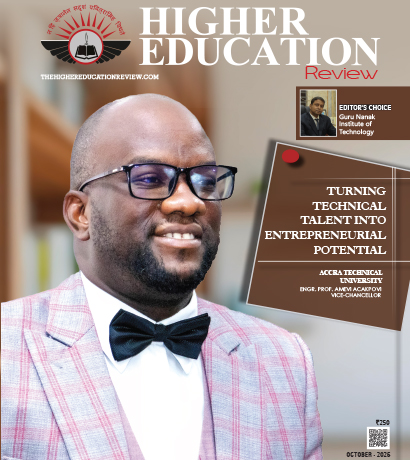
Guru Nanak Institute Of Technology (GNIT): Building a Research Ecosystem That Delivers Real-World Impact

Prof. (Dr.) Swarup Kumar Mitra, Principal, Guru Nanak Institute Of Technology (GNIT)
Engineering education is undergoing a fundamental transformation. As industries become increasingly shaped by digital technologies, automation, sustainability, and advanced manufacturing, institutions are expected to contribute far beyond classroom instruction.
Research today is measured not only through scholarly output, but also through its ability to generate intellectual property, enable entrepreneurship, address industrial challenges, and create societal value.
Guru Nanak Institute of Technology (GNIT), Kolkata, has embraced this shift by positioning research and innovation as integral to institutional growth. Through an ecosystem connecting scientific inquiry, experiential learning, industry collaboration, prototyping, and entrepreneurship, GNIT is working to ensure that ideas move beyond laboratories to become patents, funded projects, prototypes, consultancy solutions, and potentially scalable ventures.
Redefining Research Beyond Academic Publications
GNIT’s research journey reflects a conscious shift from conventional academic metrics towards outcomeoriented innovation. While publications remain an important indicator of academic excellence, the institute believes meaningful research must also address practical industrial and societal needs.
Faculty members have contributed to Scopusindexed, SCI, Web of Science, and peer-reviewed journals and participated in national and international conferences. Collectively, GNIT has developed a research portfolio comprising more than a thousand scholarly publications across journals, conference proceedings, books, and book chapters.
“Alongside publications, intellectual property has emerged as an important component of the research lifecycle. Campus innovations span Artificial Intelligence, Machine Learning, Intelligent Transportation Systems, Healthcare Technologies, Communication Engineering, Embedded Systems, Smart Manufacturing, Cyber Security, and Sustainable Engineering. By supporting researchers in translating ideas into protected technologies, GNIT is fostering a culture in which research progresses towards tangible innovation,” says Sardar Taranjit Singh, Managing Director.
”GNIT has developed an integrated support framework that encourages both faculty members and students to actively participate in innovation from the earliest stages of their academic journey”
Connecting Research, Innovation, and Industry
A defining feature of GNIT’s approach is its emphasis on connecting academia with real-world challenges. Industry engagement extends beyond internships and placements to collaborative research, consultancy, sponsored projects, and technology development.
“Industrial challenges frequently become the starting point for research initiatives undertaken by faculty members and students. Consultancy assignments and joint technical investigations expose researchers to real-world engineering problems while ensuring that academic research remains aligned with evolving industrial requirements,” adds Sardar Taranjit Singh.
Students also gain exposure to industry-sponsored projects under faculty mentorship, helping them understand the innovation cycle from problem identification and experimentation to solution development.
Through government-funded projects such as AICTE’s MODROB and MoFPI initiatives, along with industry-linked programs, GNIT facilitates sustainable development; the institute also regularly conducts national and international conferences, while its students have delivered outstanding performances at platforms such as the AICTE Chhatra Vishwakarma Awards and Smart India Hackathon.
This industry-facing approach is complemented by GNIT’s growing innovation infrastructure, particularly the GNIT AICTE IDEA Lab, inaugurated on 25 February 2026. Conceived as a future-ready innovation ecosystem, the Lab promotes hands-on learning, design thinking, prototyping, and entrepreneurship in alignment with NEP 2020 and AICTE’s experiential learning and innovation framework.
Equipped with modern fabrication tools, design facilities, and experimentation spaces, the IDEA Lab provides a collaborative environment where students and faculty from engineering, management, and allied disciplines can work on real-world challenges and transform concepts into functional prototypes and scalable solutions.
Creating a Pathway from Ideas to Entrepreneurship
GNIT’s innovation strategy seeks to ensure that promising ideas do not stop at the prototype stage. A distinctive element of the IDEA Lab ecosystem is its planned integration with JIS Idea-O-Meter, designed as a structured crowdfunding, idea-validation, and mentorship platform.
“Through Idea-O-Meter, student innovators can pitch concepts to mentors, alumni, industry experts, and potential investors, seek micro-funding support, validate market relevance, and prepare promising innovations for start-up incubation and scaling. The model is intended to create a more seamless pathway from ideation to prototyping and entrepreneurship,” shares Prof. (Dr.) Swarup Kumar Mitra, Principal.
This framework strengthens GNIT’s broader objective of creating meaningful industry–academia–start-up linkages while giving students practical exposure to the commercial and societal dimensions of innovation.
Creating a Culture Where Research Begins Early
A research-driven institution is ultimately shaped by its people. GNIT has therefore developed an integrated support framework that encourages faculty members and students to participate in research and innovation from the earliest stages of their academic journey.
“Faculty members receive institutional support for publishing in reputed journals, filing patents, preparing research proposals, securing external funding, and undertaking consultancy assignments. Regular capacitybuilding programmes on research methodology, scientific writing, proposal development, intellectual property, and innovation management ensure continuous enhancement of research capabilities across disciplines,” adds Prof. (Dr.) Swarup Kumar Mitra.
Students are introduced to research through project-based learning, multidisciplinary challenges, hackathons, faculty-led research groups, and handson experimentation. The Intellectual Property Rights Cell supports patent drafting, prior-art searches, and filing procedures, while innovation awards, publication incentives, and patent recognition further reinforce research as an essential component of academic excellence.
Building the Next Generation of Research-Driven
Engineering Education GNIT’s long-term vision is to emerge as a nationally recognised research and innovation-driven institution where knowledge creation contributes directly to industrial growth and societal development. Its roadmap includes expanding externally funded research, consultancy, interdisciplinary Centres of Excellence, high-impact publications, patents, copyrights, technology transfers, start-up incubation, and commercially viable innovations.
By connecting research with experiential learning, prototyping, mentorship, funding, entrepreneurship, and industry engagement, GNIT is building an ecosystem in which innovation can progress from an idea to measurable impact. Its evolving model reflects a larger transformation in engineering education - one where success is defined not simply by knowledge generated, but by technologies developed, ventures enabled, industrial challenges addressed, and solutions created for society.
Research today is measured not only through scholarly output, but also through its ability to generate intellectual property, enable entrepreneurship, address industrial challenges, and create societal value.
Guru Nanak Institute of Technology (GNIT), Kolkata, has embraced this shift by positioning research and innovation as integral to institutional growth. Through an ecosystem connecting scientific inquiry, experiential learning, industry collaboration, prototyping, and entrepreneurship, GNIT is working to ensure that ideas move beyond laboratories to become patents, funded projects, prototypes, consultancy solutions, and potentially scalable ventures.
Redefining Research Beyond Academic Publications
GNIT’s research journey reflects a conscious shift from conventional academic metrics towards outcomeoriented innovation. While publications remain an important indicator of academic excellence, the institute believes meaningful research must also address practical industrial and societal needs.
Faculty members have contributed to Scopusindexed, SCI, Web of Science, and peer-reviewed journals and participated in national and international conferences. Collectively, GNIT has developed a research portfolio comprising more than a thousand scholarly publications across journals, conference proceedings, books, and book chapters.
“Alongside publications, intellectual property has emerged as an important component of the research lifecycle. Campus innovations span Artificial Intelligence, Machine Learning, Intelligent Transportation Systems, Healthcare Technologies, Communication Engineering, Embedded Systems, Smart Manufacturing, Cyber Security, and Sustainable Engineering. By supporting researchers in translating ideas into protected technologies, GNIT is fostering a culture in which research progresses towards tangible innovation,” says Sardar Taranjit Singh, Managing Director.
”GNIT has developed an integrated support framework that encourages both faculty members and students to actively participate in innovation from the earliest stages of their academic journey”
Connecting Research, Innovation, and Industry
A defining feature of GNIT’s approach is its emphasis on connecting academia with real-world challenges. Industry engagement extends beyond internships and placements to collaborative research, consultancy, sponsored projects, and technology development.
“Industrial challenges frequently become the starting point for research initiatives undertaken by faculty members and students. Consultancy assignments and joint technical investigations expose researchers to real-world engineering problems while ensuring that academic research remains aligned with evolving industrial requirements,” adds Sardar Taranjit Singh.
Students also gain exposure to industry-sponsored projects under faculty mentorship, helping them understand the innovation cycle from problem identification and experimentation to solution development.
Through government-funded projects such as AICTE’s MODROB and MoFPI initiatives, along with industry-linked programs, GNIT facilitates sustainable development; the institute also regularly conducts national and international conferences, while its students have delivered outstanding performances at platforms such as the AICTE Chhatra Vishwakarma Awards and Smart India Hackathon.
This industry-facing approach is complemented by GNIT’s growing innovation infrastructure, particularly the GNIT AICTE IDEA Lab, inaugurated on 25 February 2026. Conceived as a future-ready innovation ecosystem, the Lab promotes hands-on learning, design thinking, prototyping, and entrepreneurship in alignment with NEP 2020 and AICTE’s experiential learning and innovation framework.
Equipped with modern fabrication tools, design facilities, and experimentation spaces, the IDEA Lab provides a collaborative environment where students and faculty from engineering, management, and allied disciplines can work on real-world challenges and transform concepts into functional prototypes and scalable solutions.
Creating a Pathway from Ideas to Entrepreneurship
GNIT’s innovation strategy seeks to ensure that promising ideas do not stop at the prototype stage. A distinctive element of the IDEA Lab ecosystem is its planned integration with JIS Idea-O-Meter, designed as a structured crowdfunding, idea-validation, and mentorship platform.
“Through Idea-O-Meter, student innovators can pitch concepts to mentors, alumni, industry experts, and potential investors, seek micro-funding support, validate market relevance, and prepare promising innovations for start-up incubation and scaling. The model is intended to create a more seamless pathway from ideation to prototyping and entrepreneurship,” shares Prof. (Dr.) Swarup Kumar Mitra, Principal.
This framework strengthens GNIT’s broader objective of creating meaningful industry–academia–start-up linkages while giving students practical exposure to the commercial and societal dimensions of innovation.
Creating a Culture Where Research Begins Early
A research-driven institution is ultimately shaped by its people. GNIT has therefore developed an integrated support framework that encourages faculty members and students to participate in research and innovation from the earliest stages of their academic journey.
“Faculty members receive institutional support for publishing in reputed journals, filing patents, preparing research proposals, securing external funding, and undertaking consultancy assignments. Regular capacitybuilding programmes on research methodology, scientific writing, proposal development, intellectual property, and innovation management ensure continuous enhancement of research capabilities across disciplines,” adds Prof. (Dr.) Swarup Kumar Mitra.
Students are introduced to research through project-based learning, multidisciplinary challenges, hackathons, faculty-led research groups, and handson experimentation. The Intellectual Property Rights Cell supports patent drafting, prior-art searches, and filing procedures, while innovation awards, publication incentives, and patent recognition further reinforce research as an essential component of academic excellence.
Building the Next Generation of Research-Driven
Engineering Education GNIT’s long-term vision is to emerge as a nationally recognised research and innovation-driven institution where knowledge creation contributes directly to industrial growth and societal development. Its roadmap includes expanding externally funded research, consultancy, interdisciplinary Centres of Excellence, high-impact publications, patents, copyrights, technology transfers, start-up incubation, and commercially viable innovations.
By connecting research with experiential learning, prototyping, mentorship, funding, entrepreneurship, and industry engagement, GNIT is building an ecosystem in which innovation can progress from an idea to measurable impact. Its evolving model reflects a larger transformation in engineering education - one where success is defined not simply by knowledge generated, but by technologies developed, ventures enabled, industrial challenges addressed, and solutions created for society.
Current Issue