National Research Mordovia State University: A Powerhouse Shaping Russia’s Global Academic Future
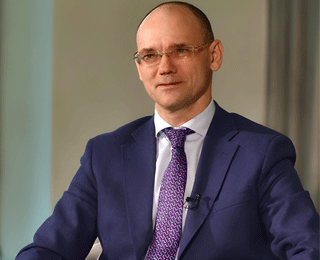
National Research Mordovia State University, Rector
Russia has long held a distinguished position in global higher education, with institutions such as Lomonosov Moscow State University and Saint Petersburg State University symbolizing the country’s intellectual depth and scientific rigor. Russian universities are particularly renowned for their strengths in engineering, medicine, physics, and mathematics, fields that have historically driven the nation’s technological and industrial progress. The system combines classical academic traditions with strong research integration, offering a wide spectrum of programs from humanities to cutting-edge biotechnology. Over the decades, Russia has cultivated a reputation for producing globally competitive graduates while maintaining affordable tuition structures and strong state-supported research ecosystems.
For Indian students, Russia represents a compelling academic destination. The country’s medical and engineering programs, globally recognized degrees, and cost-effective education model make it especially attractive. Thousands of Indian students pursue medical education in Russia every year, drawn by robust clinical exposure and internationally aligned curricula. The cultural ties between India and Russia further strengthen this academic exchange.
Within this landscape stands National Research Mordovia State University, one of Russia’s leading classical institutions and a designated National Research University. Located in Saransk, the capital of the Republic of Mordovia, the university embodies a powerful blend of tradition, innovation, and global ambition. Founded in 1931 as a teacher training institute, it has evolved into a comprehensive academic and scientific center with nearly a century of educational excellence. Today, it stands as the region’s intellectual backbone, shaping professionals, scientists, and leaders across disciplines.
Academic Breadth, Interdisciplinary Strength, and Research Excellence
As a classical university, National Research Mordovia State University derives its strength from academic diversity. With 295 degree programs across natural sciences, engineering, medicine, humanities, and social sciences, the institution offers a comprehensive educational ecosystem. Its Medical Institute remains one of its defining pillars, training healthcare professionals who serve not only the Republic of Mordovia but also major Russian cities. Nearly 99 percent of healthcare professionals in the region are alumni of the university, a testament to its deep regional impact.
The university’s engineering and materials science programs reflect Mordovia’s industrial profile, particularly in cable production, fiber optics, radio electronics, and microelectronics. Close collaboration with industrial enterprises ensures that academic programs align with real workforce demands. Students frequently gain employment even before graduation, benefiting from structured internships and enterprise-linked projects.
Research is deeply embedded in the university’s structure. With 127 laboratories and research centers, including three resource-sharing centers, the institution operates at a scale comparable to major research universities. During the COVID-19 pandemic, one of Russia’s first medications for the virus was developed within its laboratories, demonstrating both scientific capability and rapid innovation. Notably, students actively participated in this research, reflecting the university’s commitment to experiential learning.
Interdisciplinary collaboration defines its modern research model. Biotechnology, biomedicine, agriculture, ecology, and materials science are integrated through cross-disciplinary teams that include economists, legal scholars, and philosophers. The presence of a Federal Center for Biotechnology and Biomedicine, established by presidential decree, strengthens the university’s global research positioning. By directly transferring laboratory discoveries into the educational process, the institution ensures that students across all disciplines gain exposure to digital technologies and artificial intelligence applications.
"With 295 degree programs across natural sciences, engineering, medicine, humanities, and social sciences, the institution offers a comprehensive educational ecosystem
Global Community, Student Experience, and Admission Pathways
Internationalization is a central pillar of National Research Mordovia State University’s identity. With nearly 20,000 students, including more than 4,000 international learners from over 50 countries, the campus reflects a truly multicultural academic environment. Approximately one quarter of the student body is international, creating a vibrant cross-cultural atmosphere that extends beyond classrooms into festivals, research collaborations, and community engagement.
The university places strong emphasis on student wellbeing and integration. International students are supported from the moment of admission through structured onboarding processes, accommodation assistance, and cultural orientation. The goal is clear: every student should experience Saransk as a “home away from home.” Digital infrastructure further enhances accessibility, with all academic buildings and dormitories connected through broadband systems and the Electronic Information and Education Environment, allowing seamless academic management via web and mobile platforms.
Admission for international students follows a structured and transparent procedure. Applicants create a personal account on the university portal, upload legalized academic documents, and participate in online entrance examinations. Upon successful completion, a learning agreement is signed, and a visa invitation is issued. This streamlined process ensures accessibility while maintaining academic standards. The university’s global partnerships further reinforce its international character. It has established a representative office in India and maintains strong academic collaboration with SRM Institute of Science and Technology. A Russian Language and Culture Center supported by the university operates in Chennai, preparing Indian students for academic integration in Russia. Collaborative conferences, student exchanges, and joint research initiatives highlight a growing Indo-Russian academic synergy.
Strategic Growth, Innovation, and Lifelong Learning
Looking ahead, National Research Mordovia State University has articulated a clear strategic roadmap extending beyond 2030. Two primary priorities define its long-term vision: biotechnology and materials science. In biotechnology, the university integrates pharmaceutical development, food technologies, agriculture, veterinary sciences, and chemical engineering into a unified research and education cluster. Projects conducted in partnership with major pharmaceutical and agricultural enterprises underscore its industry-driven innovation model.
Materials science forms the second strategic axis, addressing the needs of radio electronics, microelectronics, optical fiber production, and advanced chemical manufacturing. Research in ultra-pure substances, smart construction materials, and photonics supports both regional industrial growth and national technological advancement. These focus areas position the university as a key contributor to Russia’s knowledge economy.
Medical education remains equally central to the future strategy. With advanced simulation and accreditation centers, integrated clinical departments within hospitals, and strong international licensing outcomes, the university continues to strengthen its reputation in global medical education. Graduates have demonstrated exceptional performance in competitive national examinations abroad, reinforcing academic credibility.
Lifelong learning represents another cornerstone of institutional growth. Through its Institute of Corporate Education and Continuing Professional Development, the university provides tailored retraining programs for industry leaders and employees. Partnerships with enterprises such as OpticEnergo have led to customized educational pathways, enabling engineers and executives to pursue advanced degrees aligned with corporate strategies. This approach ensures that education extends beyond traditional degree cycles, supporting workforce upskilling in a dynamic economy.
At its core, National Research Mordovia State University remains guided by a mission rooted in individuality, innovation, and societal contribution. It upholds the ideals of academic freedom while integrating digital technologies and entrepreneurial thinking into every level of education. By combining fundamental science, applied research, medical excellence, engineering innovation, and humanitarian scholarship within a single ecosystem, the university exemplifies the modern classical institution.
As global higher education continues to evolve under digital transformation and international collaboration, National Research Mordovia State University stands as a powerful testament to how tradition and innovation can coexist. With nearly a century of legacy and a forward-looking strategy, it continues to shape not only the Republic of Mordovia but also the broader global academic landscape.
For Indian students, Russia represents a compelling academic destination. The country’s medical and engineering programs, globally recognized degrees, and cost-effective education model make it especially attractive. Thousands of Indian students pursue medical education in Russia every year, drawn by robust clinical exposure and internationally aligned curricula. The cultural ties between India and Russia further strengthen this academic exchange.
Within this landscape stands National Research Mordovia State University, one of Russia’s leading classical institutions and a designated National Research University. Located in Saransk, the capital of the Republic of Mordovia, the university embodies a powerful blend of tradition, innovation, and global ambition. Founded in 1931 as a teacher training institute, it has evolved into a comprehensive academic and scientific center with nearly a century of educational excellence. Today, it stands as the region’s intellectual backbone, shaping professionals, scientists, and leaders across disciplines.
Academic Breadth, Interdisciplinary Strength, and Research Excellence
As a classical university, National Research Mordovia State University derives its strength from academic diversity. With 295 degree programs across natural sciences, engineering, medicine, humanities, and social sciences, the institution offers a comprehensive educational ecosystem. Its Medical Institute remains one of its defining pillars, training healthcare professionals who serve not only the Republic of Mordovia but also major Russian cities. Nearly 99 percent of healthcare professionals in the region are alumni of the university, a testament to its deep regional impact.
The university’s engineering and materials science programs reflect Mordovia’s industrial profile, particularly in cable production, fiber optics, radio electronics, and microelectronics. Close collaboration with industrial enterprises ensures that academic programs align with real workforce demands. Students frequently gain employment even before graduation, benefiting from structured internships and enterprise-linked projects.
Research is deeply embedded in the university’s structure. With 127 laboratories and research centers, including three resource-sharing centers, the institution operates at a scale comparable to major research universities. During the COVID-19 pandemic, one of Russia’s first medications for the virus was developed within its laboratories, demonstrating both scientific capability and rapid innovation. Notably, students actively participated in this research, reflecting the university’s commitment to experiential learning.
Interdisciplinary collaboration defines its modern research model. Biotechnology, biomedicine, agriculture, ecology, and materials science are integrated through cross-disciplinary teams that include economists, legal scholars, and philosophers. The presence of a Federal Center for Biotechnology and Biomedicine, established by presidential decree, strengthens the university’s global research positioning. By directly transferring laboratory discoveries into the educational process, the institution ensures that students across all disciplines gain exposure to digital technologies and artificial intelligence applications.
"With 295 degree programs across natural sciences, engineering, medicine, humanities, and social sciences, the institution offers a comprehensive educational ecosystem
Global Community, Student Experience, and Admission Pathways
Internationalization is a central pillar of National Research Mordovia State University’s identity. With nearly 20,000 students, including more than 4,000 international learners from over 50 countries, the campus reflects a truly multicultural academic environment. Approximately one quarter of the student body is international, creating a vibrant cross-cultural atmosphere that extends beyond classrooms into festivals, research collaborations, and community engagement.
The university places strong emphasis on student wellbeing and integration. International students are supported from the moment of admission through structured onboarding processes, accommodation assistance, and cultural orientation. The goal is clear: every student should experience Saransk as a “home away from home.” Digital infrastructure further enhances accessibility, with all academic buildings and dormitories connected through broadband systems and the Electronic Information and Education Environment, allowing seamless academic management via web and mobile platforms.
Admission for international students follows a structured and transparent procedure. Applicants create a personal account on the university portal, upload legalized academic documents, and participate in online entrance examinations. Upon successful completion, a learning agreement is signed, and a visa invitation is issued. This streamlined process ensures accessibility while maintaining academic standards. The university’s global partnerships further reinforce its international character. It has established a representative office in India and maintains strong academic collaboration with SRM Institute of Science and Technology. A Russian Language and Culture Center supported by the university operates in Chennai, preparing Indian students for academic integration in Russia. Collaborative conferences, student exchanges, and joint research initiatives highlight a growing Indo-Russian academic synergy.
Strategic Growth, Innovation, and Lifelong Learning
Looking ahead, National Research Mordovia State University has articulated a clear strategic roadmap extending beyond 2030. Two primary priorities define its long-term vision: biotechnology and materials science. In biotechnology, the university integrates pharmaceutical development, food technologies, agriculture, veterinary sciences, and chemical engineering into a unified research and education cluster. Projects conducted in partnership with major pharmaceutical and agricultural enterprises underscore its industry-driven innovation model.
Materials science forms the second strategic axis, addressing the needs of radio electronics, microelectronics, optical fiber production, and advanced chemical manufacturing. Research in ultra-pure substances, smart construction materials, and photonics supports both regional industrial growth and national technological advancement. These focus areas position the university as a key contributor to Russia’s knowledge economy.
Medical education remains equally central to the future strategy. With advanced simulation and accreditation centers, integrated clinical departments within hospitals, and strong international licensing outcomes, the university continues to strengthen its reputation in global medical education. Graduates have demonstrated exceptional performance in competitive national examinations abroad, reinforcing academic credibility.
Lifelong learning represents another cornerstone of institutional growth. Through its Institute of Corporate Education and Continuing Professional Development, the university provides tailored retraining programs for industry leaders and employees. Partnerships with enterprises such as OpticEnergo have led to customized educational pathways, enabling engineers and executives to pursue advanced degrees aligned with corporate strategies. This approach ensures that education extends beyond traditional degree cycles, supporting workforce upskilling in a dynamic economy.
At its core, National Research Mordovia State University remains guided by a mission rooted in individuality, innovation, and societal contribution. It upholds the ideals of academic freedom while integrating digital technologies and entrepreneurial thinking into every level of education. By combining fundamental science, applied research, medical excellence, engineering innovation, and humanitarian scholarship within a single ecosystem, the university exemplifies the modern classical institution.
As global higher education continues to evolve under digital transformation and international collaboration, National Research Mordovia State University stands as a powerful testament to how tradition and innovation can coexist. With nearly a century of legacy and a forward-looking strategy, it continues to shape not only the Republic of Mordovia but also the broader global academic landscape.
Current Issue
.jpg)