
Why MBA Graduates need Multidisciplinary Thinking Skills
 The world is changing at an extraordinary pace. As you read this, chances are that two stories are dominating global headlines. One is the launch of yet another powerful AI model by a technology company, accompanied by discussions about how it will transform industries and automate jobs or displace workforce.
The other is the news of a geopolitical shock, whether an armed conflict, a trade dispute, economic sanctions, or escalating tensions between nations that don't seem to have an end date. Not long ago, such developments were viewed as rare events that organizations could address through some contingency planning.
Today, they have become recurring features of the global business landscape. When disruption becomes routine rather than exception, businesses can no longer rely on traditional ways of operating. They must continuously adapt, rethink their business models, and build greater resilience. More importantly, the talent which is a part of these organizations must evolve to be able to navigate a world where technology and geopolitics shape business decisions every day.
Beyond the increasing frequency of disruptive events, the nature of the challenges confronting businesses has become far more complex. Many of these challenges are characterized by incomplete information, conflicting stakeholder interests, and dynamically changing circumstances. There are rarely any straightforward solutions to these problems, and every decision can create new trade-offs or unintended consequences.
For instance, a global sourcing manager working towards procuring a key component had to worry mainly about costs, quality and competition in the past, all of which could be fed into a supply chain planning solution to provide a near-optimal solution. With major ports facing disruption, trade wars, and tariffs declared at whim, there is little that the planning software can do to help this sourcing manager.
Addressing such problems demands more than deep expertise in a single functional area. It requires systems thinking - the ability to connect ideas across disciplines, synthesize diverse perspectives, and evaluate problems through multiple lenses. This capacity for multidisciplinary thinking is becoming an essential competency for MBA graduates entering the workforce during these interesting times.
Many MBA students choose to specialize in functional areas such as Finance, Marketing, Operations, or Analytics, often devoting most of their academic efforts to building expertise within these domains and, in the process, giving comparatively less attention to building knowledge in complementary areas.
Also Read: How Transdisciplinary Education Shapes the Future of Learning
While such specialization is valuable, it can inadvertently limit exposure to equally important areas, including geopolitics, public policy, law, ethics, sustainability, and technology governance. In today's business environment, where managerial decisions are increasingly shaped by forces beyond traditional business functions, a narrow knowledge base is often insufficient to address complex, interconnected challenges.
A marketing manager's pursuit to choose the right channel for the product without an understanding of the above areas would be like solving an optimization problem without considering the constraints. Moreover, the nature of work itself is evolving rapidly.
Advances in artificial intelligence, automation, and digital technologies are continuously reshaping organizational structures, job roles, and decision-making processes. MBA graduates must therefore recognize that the knowledge and skills acquired during their degree are only the starting point of their professional journey.
Their long-term success will depend on cultivating a lifelong learning mindset, remaining intellectually curious, embracing emerging technologies as enablers rather than viewing them as threats, and continuously adapting to new business realities. Adaptability and willingness to learn will prove to be equally important as technical expertise.
Alongside this mindset, MBA students should consciously develop a set of enduring managerial capabilities that complement their chosen specialization. Beyond the specializations typically offered at most business schools, students should aim to acquire skills in technology integration (especially AI literacy), negotiation, stakeholder management, ethical reasoning, and collaborative leadership, which are difficult for a machine to master.
Students should also strengthen their capabilities in scenario planning, risk analysis, simulations, and resilience planning. Rather than searching for a single optimal answer, they should learn to evaluate multiple plausible futures and prepare contingency strategies. This is similar to the T-shaped learning approach.
These evolving capabilities are precisely what employers seek in MBA graduates today. While functional expertise remains important, organizations increasingly value professionals who can look beyond their specialization, interpret emerging market trends, understand the customer pulse, think strategically across functions, and leverage technology to create business value.
They value managers who can combine analytical rigor with strategic foresight, technological literacy with ethical judgment, and commercial acumen with geopolitical awareness. The ideal MBA graduate for them is not merely a finance expert, marketer, or operations specialist, but someone who can integrate knowledge from multiple domains, collaborate across disciplines, and confidently navigate an increasingly uncertain technology-enabled business environment.
Also Read: CFO Aneel Gambhir Unveils Keys to Revenue, Leadership & Growth
Global CRM leader, Salesforce combined the roles of Chief Operating Officer and Chief Financial Officer to make Robin Washington the Chief Operating and Financial Officer validating the importance of multi-disciplinary thinking.
Leading business schools have recognized this shift and are continually reimagining management education. Over the past few years, for example, significant attention has been devoted to exploring both the potential and the ethical implications of artificial intelligence in teaching and learning.
Research continues to play a central role in this evolution. Insights generated through action research find their way into classrooms, ensuring that curricula remain aligned with emerging business realities and equipping students with frameworks to address tomorrow's challenges. At the same time, AI is also enabling business schools to introduce immersive simulations, intelligent tutoring systems, personalized learning experiences, and innovative pedagogical approaches that make management education more engaging and experiential.
Personally, I was able to develop several short simulations to aid the learning of individuals on complex topics related to operations and supply chain management. A custom GPT was also created to act as a teaching assistant solving student queries at times when the instructor was not available. These developments not only enrich the learning experience but also prepare graduates to become thoughtful, adaptable, and responsible leaders.
The complexities discussed above are here to stay. Artificial intelligence is transforming how decisions are made, while geopolitical uncertainty is reshaping how businesses compete, collaborate, and grow. Future belongs not to managers who compete with AI, but to those who understand how to harness AI responsibly while navigating an increasingly interconnected and uncertain global environment.
MBA graduates who cultivate intellectual curiosity, embrace interdisciplinary thinking, and remain adaptable in the face of change will not only build resilient careers but will also play a pivotal role in shaping the future of business.
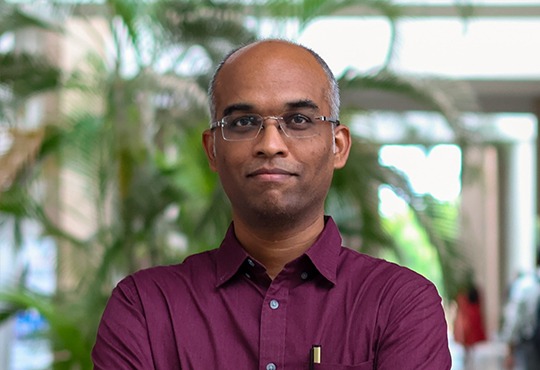
About Sirish Kumar Gouda, Faculty - Operations Management and Decision Sciences Area, Indian Institute of Management Tiruchirappalli :
Prof. Sirish Kumar Gouda is an Associate Professor in the Operations Management and Decision Sciences area. He holds a doctoral degree from the Indian Institute of Management Bangalore and a bachelor’s degree from NIT Warangal. He has prior work experience in the areas of supply chain consulting, EdTech, and financial inclusion.
Current Issue
.jpg)