IIM Ranchi Launches Executive Leadership Program for SAIL
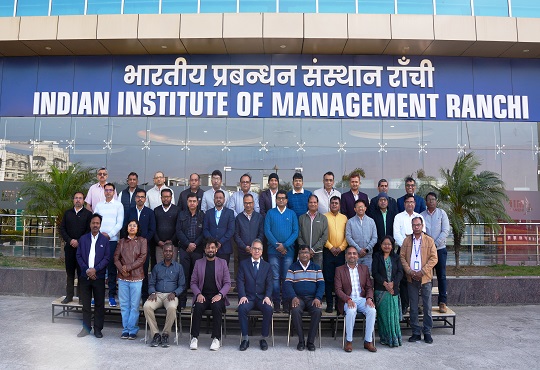 IIM Ranchi inaugurated the 5th Batch of the Executive Leadership Programme for the executives of Steel Authority of India Limited (SAIL), marking the commencement of Phase I of the programme. The first phase is a five-day residential module, scheduled from January 13 to January 17, 2026, and is being conducted on the IIM Ranchi campus.
The programme has been structured into three phases, comprising two on-campus modules at IIM Ranchi and one online phase. It is designed to strengthen leadership capabilities, strategic thinking, and managerial effectiveness among 30 newly promoted Deputy General Managers (DGMs) of SAIL, in the context of rapidly evolving organizational and industry challenges.
The inauguration began with a welcome address by Prof. Manish Bansal, Programme Director and Chairperson, Executive Education & Consulting (EEC), IIM Ranchi. He emphasized that leadership at senior levels is defined not merely by designation, but by character, courage in decision-making, and the ability to influence through evidence-based and data-driven insights. He highlighted that the programme has been carefully designed through extensive deliberations to ensure relevance, academic rigor, and meaningful outcomes, and wished the participants an intensive and reflective learning journey.
Following the welcome address, a lamp lighting ceremony and invocation were held, formally inaugurating the programme.
Also Read: How Data Science is Powering Predictive Analytics in Malaysia
Addressing the gathering, Prof. Amit Sachan, Dean EEC, IIM Ranchi, underscored the importance of continuous learning and embracing new challenges in leadership roles. He explained that learnings from the first phase would be translated into action learning projects within participants’ organizations, followed by reflection and reinforcement in subsequent phases. He noted the programme’s focus on the realities of public sector organizations, particularly balancing efficiency, accountability, and diverse stakeholder expectations. Emphasizing a hands-on and application-oriented approach, he highlighted the use of practical frameworks, case analyses, live discussions, and laboratory-style sessions, encouraging active participation and peer learning.
The Chief Guest, Shri Sanjay Dhar, Executive Director (HR Learning & Development), SAIL, set the organizational context for the programme. He highlighted that the participants are at a critical inflection point in their careers, coinciding with a phase of significant transformation within SAIL, including large-scale retirements and initiatives in digital transformation, HR transformation, safety culture, and enterprise systems implementation. He noted that these changes demand adaptability, a faster learning curve, and a deeper understanding of management fundamentals.
Shri Dhar emphasized the importance of blending internal organizational knowledge with external perspectives, stating that sustainable leadership and innovation emerge when experience aligns with contemporary management theory and global best practices. He elaborated on the programme’s multi-phase design, highlighting experiential learning, action and reflection, and theory-to-practice integration in developing applied intelligence. He encouraged participants to remain open-minded, curious, and actively engaged, viewing the programme as part of a lifelong learning journey.
The inaugural session concluded with a vote of thanks by Prof. Krishna Kumar Dadsena, Programme Director, who welcomed the participants to IIM Ranchi and expressed gratitude to Shri Sanjay Dhar for his continued support. He acknowledged the efforts of the academic leadership and faculty, thanked the administrative and support staff, and appreciated the participants for travelling from across the country, reaffirming IIM Ranchi’s commitment to executive education excellence.
The Executive Leadership Programme reflects IIM Ranchi’s continued focus on executive education and leadership development, aimed at strengthening institutional capacity and nurturing future-ready leaders in the public sector.
Current Issue