How AI Opens Career Paths Beyond Degrees for Tier-2 Students
 Two engineering graduates. Identical degrees. Same technical proficiency. Yet their career trajectories couldn't be more different. One, from IIT Bombay, fields multiple offers from multinational corporations. The other, from a reputed engineering college in Coimbatore, struggles to secure even a single interview call. This isn't a hypothetical scenario — it's the lived reality for millions of Indian graduates each year.
According to the India Skills Report 2024 published by Wheebox in partnership with AICTE, employability rates among graduates from metropolitan cities hover around 54 per cent, while their counterparts in Tier-2 cities languish at approximately 38 per cent. The All India Survey on Higher Education reveals that nearly 47 per cent of Indian graduates remain unemployable by industry standards — not because they lack capability, but because they cannot effectively communicate their worth.
The Employability Crisis Nobody Discusses
Cities like Surat, Indore, Coimbatore, and Kochi represent India's emerging economic powerhouses. They house some of the country's finest educational institutions and produce technically competent graduates by the thousands. These aren't obscure towns—they rank among India's fastest-growing urban centres. Yet recruitment data tells a troubling story: graduates from these cities receive 40 per cent fewer interview callbacks compared to their metropolitan peers, despite possessing comparable qualifications.
The paradox is striking. Surat alone produces over 15,000 engineering graduates annually. Indore's management institutes rival their metropolitan counterparts in academic rigour. Coimbatore's technical colleges maintain impressive placement statistics within local industries. Kochi's finance graduates demonstrate remarkable analytical capabilities. The talent exists in abundance.
So what explains the gap?
The answer lies not in capability but in presentation. Students from vernacular-medium backgrounds — those educated primarily in regional languages—face a fundamental disadvantage when competing for positions at national or multinational companies. Their resumes, often drafted without professional guidance, fail to articulate achievements in formats that applicant tracking systems can parse. Their interview responses, while technically accurate, lack the polished delivery that corporate recruiters expect.
Career counselling, a standard feature at premium institutions, remains a luxury in most Tier-2 colleges. Dedicated placement cells with corporate connections are rare. Professional resume review services cost money that most families cannot spare. Students navigate the job market armed with generic resume templates downloaded from the internet and advice passed down from seniors who faced similar struggles. The cycle perpetuates itself, generation after generation, leaving exceptional talent undiscovered.
The core issue isn't talent deficiency. It's a marketing problem — these graduates simply don't know how to package and present their genuine capabilities.
Technology as the Great Equaliser
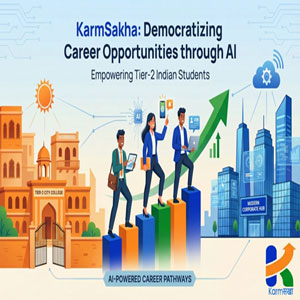
This is where technology levels the playing field. Platforms like KarmSakha are using AI to help students from vernacular backgrounds create Fortune-500 style resumes in seconds, removing the language barrier that has historically disadvantaged non-English speakers.
The transformation is tangible. Consider Priya, a mechanical engineering graduate from Anna University's affiliated college in Coimbatore. Educated primarily in Tamil medium until her undergraduate degree, she possessed strong technical knowledge but struggled to articulate it professionally. Her initial resume — a basic Word document with inconsistent formatting —generated zero responses across 200 applications.
After using an AI-powered resume builder that offered interface support in Tamil, Priya created an ATS-optimised resume highlighting her project achievements in corporate-standard language. Within three weeks, she received interview calls from four multinational manufacturing firms. She now works as a quality engineer at a Fortune 500 automotive company.
Rahul's story from Indore follows a similar arc. A commerce graduate from a local college, he aspired to crack the banking sector examinations but lacked access to quality preparation resources. The IBPS PO exam demands more than textbook knowledge — candidates must stay abreast of current affairs and demonstrate exam-taking proficiency. Through AI-powered mock tests conducted in Hindi, with instant feedback on his responses, Rahul transformed his preparation strategy. He cleared the examination on his second attempt, attributing his success to structured practice previously available only to those who could afford expensive coaching.
The numbers substantiate these individual narratives. AI-powered career platforms now serve over one million job seekers across India, with a particular focus on government job aspirants from non-metropolitan regions. These platforms add over 12,000 verified opportunities daily, aggregate listings from more than 50 official sources, and support job searches in ten Indian languages — ensuring that a student in Kochi enjoys the same access to opportunities as one in Bangalore.
The impact extends beyond resume creation. Sneha, a textile engineering graduate from Surat educated entirely in Gujarati medium, discovered that her traditional job search approach — applying through local consultancies — severely limited her options. Her technical knowledge was sound, but corporate communication felt alien. Through English learning modules designed for professional contexts, she developed the vocabulary and confidence needed for corporate environments. Within months, she secured a role at a national apparel export house, where she now heads quality assurance — commanding a salary she once thought unattainable.
Data from these platforms indicates that users experience a threefold increase in interview callbacks and save approximately 60 per cent of time previously spent on applications. More importantly, the technology democratises access to career resources that were historically gatekept by expensive consultants and premium institution placements cells.
The Road Ahead
The implications for higher education are profound and far-reaching. As AI-first hiring becomes standard practice across industries, the traditional advantages of institutional pedigree will gradually diminish. Skills-based assessment, powered by machine learning algorithms that evaluate candidates on merit rather than background, will replace the subjective biases that currently favour metropolitan graduates. The playing field is being levelled, one application at a time.
Educational institutions in Tier-2 cities have an opportunity — and an obligation — to integrate these technologies into their career development programmes. The cost barrier that once justified unequal access no longer exists. What remains is the inertia of established systems and the hesitation to embrace change.
The future of employment in India will not be determined by geography. Technology has ensured that a talented graduate from Indore can compete on equal footing with one from Delhi. The degree remains important, but what lies beyond it — the presentation, the preparation, the access to opportunities — need no longer depend on where one studied.
Current Issue